

Introduction
In the current age of information selling, companies gather huge volumes of customer data to design relevant experiences that prompt behavior change. Nonetheless, even the most complicated marketing campaigns can fail if the customer database is dirty. Data cleansing is the process of cleaning data that involves checking for customer accuracy, compliance and currency of the information collected in order to construct a Unified Customer Database. It pulls information from several interaction points like a CRM, social media, and e-mail platforms and gives a central customer picture.
But it becomes easy when data collected is accurate, contains no redundancy and does not pose any contradiction. Thus, low data quality damages customer data quality distorts customer profiles produces wrong campaigns offers wrong recommendations and lost opportunities to engage customers. This blog post discusses why data cleansing is a crucial utility for good customer database assembly to fan personalization campaigns and outlines advice on how to keep the data fresh, clean and raring to go for marketers.
What is Data Cleansing?
Data cleansing is the process of detecting and correcting inaccurate, corrupt, or irrelevant records from a database. This can include correcting typos, merging duplicate entries, and standardizing inconsistent formats, all to ensure the database is accurate, complete, and up-to-date.
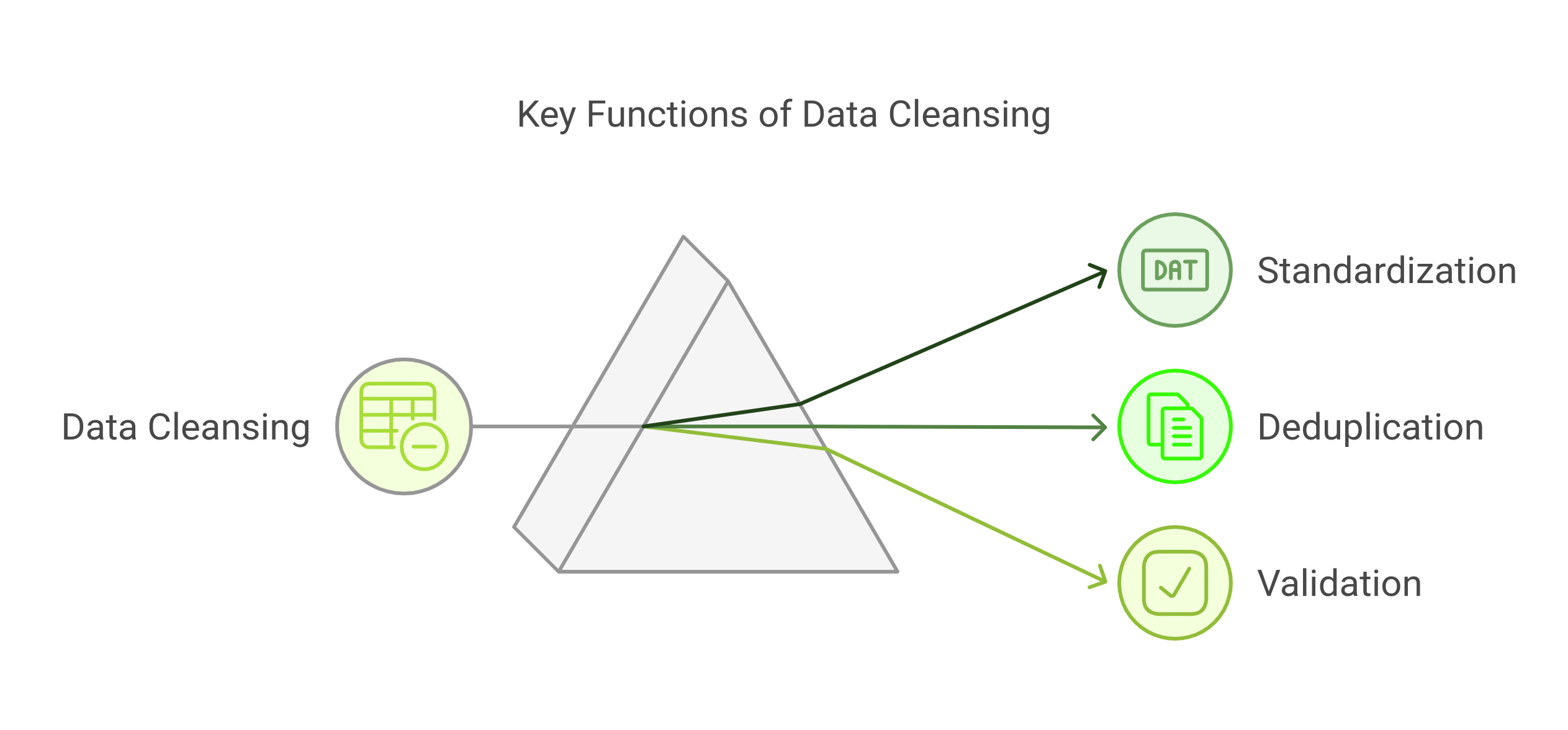
- Standardization: Bringing data formats (phone numbers, dates, etc.) in-line to ensure consistency throughout the database
- Deduplication: Removing duplicate entries that may distort insights and causing unnecessary inefficiencies.
- Validation: A validation process is in place to ensure that any data is indeed accurate and relevant and, therefore, guides the current customer reality.
Data cleansing is also critical within the context of a unified customer database. The unified customer database will only be able to connect information from various sources with clean data, storing data if possible and improving customer records over time. This divergence obstructs the ability to identify customer preferences, predict behaviors, and provide tailored experiences. Investing in data cleansing opens the door to make way for the new world of personalized experiences, data-related compliance, correct decision-making, etc.
The Importance of Data Cleansing
Data cleansing functions beyond its status as background work because it establishes core foundations for effective customer relationships alongside business success. Here’s why it’s crucial for organizations, especially when building and maintaining a unified customer database:
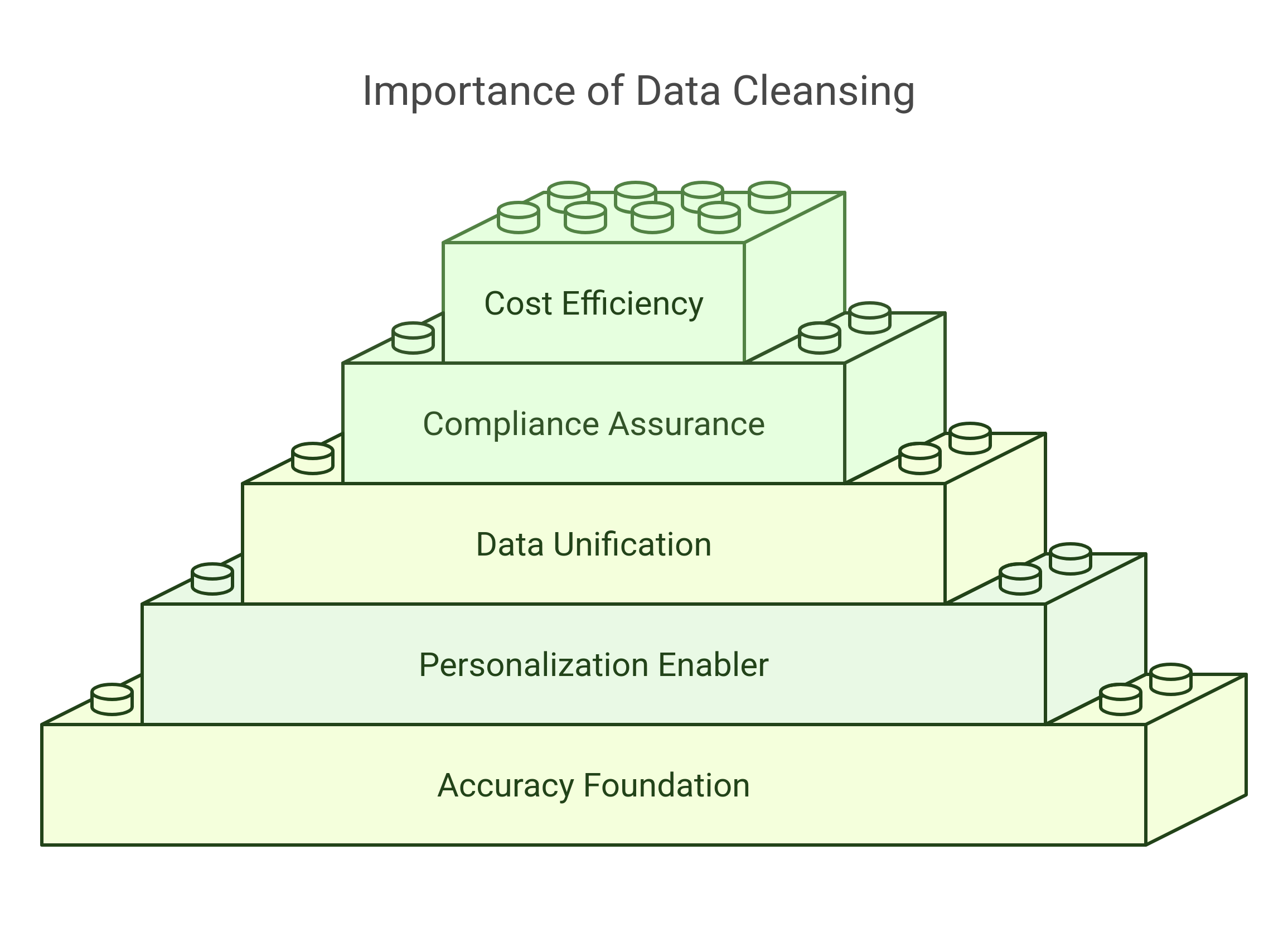
Foundation of Accuracy
Your customer insights gain both accuracy and practicality when the data remains clean. Decision-makers can depend on reliable data for their strategic decisions because a complete absence of data errors and redundant and inconsistent elements exists. The usage of imprecise data creates initiatives depart course thus resulting in missed possibilities.
Enabler of Personalization
To establish personalization businesses need exact segmentation methods that reveal customer preferences together with behavioral patterns and individual requirements. When data remains unclean consumers experience irrelevant suggestions alongside bad targeted messages that damage their trust while decreasing their engagement. Data cleansing creates accurate customer profiles which allows businesses to personalize experiences to exact specifications.
Data Unification
A unified database combines all relevant customer information that exists across multiple systems including CRM platforms marketing tools and e-commerce systems. Data cleansing exists as an essential practice that enables process elimination of duplications while standardizing document formats and guaranteeing synchronized records within split information repositories. This data consolidation guarantees a unified perspective of each customer through the Unified database to support strategic decisions and cross-platform marketing initiatives.
Compliance Assurance
The GDPR along with the CCPA requires enterprises to store precise customer information which also stays protected and valid. Through data cleansing organizations prevent noncompliance by getting rid of irrelevant or obsolete records while maintaining legal and ethical data standards. Businesses reduce their penalty risk and gain customer trust through proper compliance.
Cost Efficiency
Data mistakes trigger wastage of valuable company resources through task restoration costs as well as misdirected campaign spending and system performance degradation. Businesses that actively clean their data enable smooth workflows while maximizing process efficiency and earning savings from removing bad data costs. Organizational reputation stays untarnished when data stays clean because lack of customer contentment becomes less likely therefore sustaining future business income.
Benefits of Data Cleansing for Unified Customer Database
A unified customer database gains its entire value from reliable data quality. By incorporating robust data cleansing practices, businesses can unlock several key benefits:
Improved Accuracy
Through data cleansing organizations achieve accurate data results by ensuring consistent trustworthy information persists within the Unified customer database. Businesses gain marketing campaign success through accurate segmentation made possible by dependable database information. The process of removing outdated information (such as Email addresses) combined with correcting inaccurate demographic entries in cleaned databases translates into optimal customer understanding and enhanced decision clarity.
Enhanced Customer Experience
Personalization relies on obtaining precise up-to-date customer profiles. Businesses use clean data to supply personalized recommendations and moment-timely alerts in conjunction with custom-made messaging that improves customer satisfaction. A brand can develop meaningful customer relationships by using precise purchase history information to suggest supplementary products which will boost customer satisfaction.
Operational Efficiency
Duplicate and spare data records create performance limitations that waste time and needed resources for data supervision work. Data cleansing minimizes operational complexities by optimizing workflow performance while establishing system-wide seamless interconnections. A cleanse process enables teams across marketing sales and customer support to work together more efficiently with reliable error-free information to make better decisions faster.
Regulatory Compliance
Organizations must keep their information clean and relevant to maintain compliance with data privacy regulations including GDPR along with CCPA. Clean data operations eliminate unnecessary historical or useless data points thus organizations maintain compliance standards and protect customer privacy. Data of high quality provides businesses with protection against penalties and reputational damage arising from non-compliance actions.
Consequences of Poor Data Hygiene in Unified Customer Databases
A unified customer database which fails to maintain proper data hygiene begins a chain of problems that damages both customer relationships and operational performance and compliance requirements. Here are some of the most significant consequences:
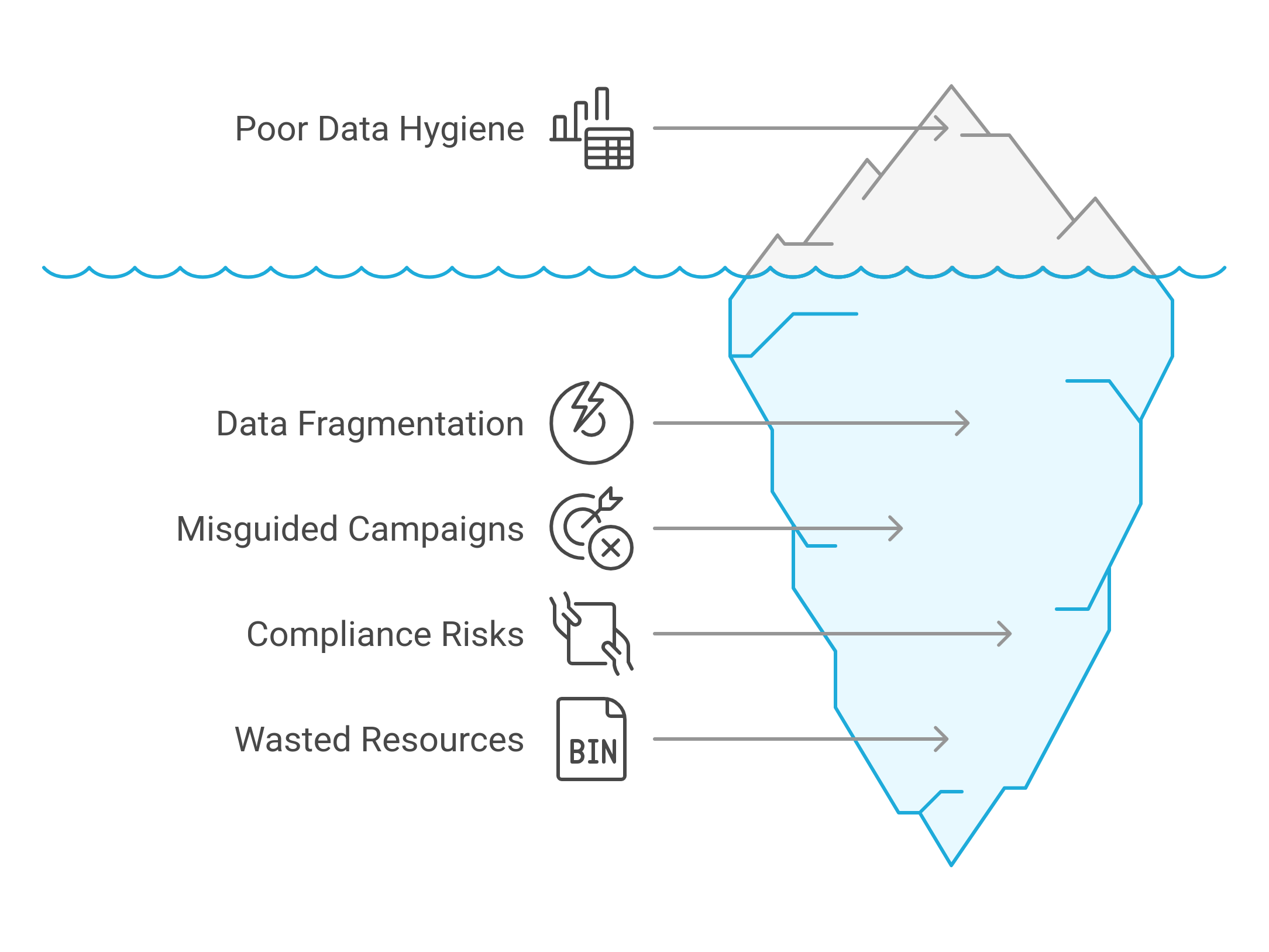
Data Fragmentation
The lack of data cleansing leads to repeated information along with inconsistent data which causes weak and erroneous customer profiles. Each break in customer data connectivity produces separated customer details which reduces the effectiveness of behavior tracking and purchase history record maintenance. Customers who engage with more than one channel end up appearing twice or multiple times because of missing data records which breaks down the necessary consistency for suitable personalized experiences.
Misguided Campaigns
Faulty segmentation models stem directly from invalid customer data. Irrelevant messaging and poorly executed campaigns occur because of inaccurate contact information or duplicate record entries along with incorrect demographic information. Promotional offers to customers with opt-out status plus irrelevant promotional products can hurt brand reputation while decreasing campaign return on investment.
Compliance Risks
The GDPR and CCPA data privacy regulations force businesses to keep their customer information current and meaningful. Improper data hygiene practices raise the danger of holding inappropriate outdated or intrusive customer records which may break regulatory compliance rules. Breach violations produce substantial monetary penalties alongside severe trust breakdowns between customers and businesses which makes compliance an absolute need.
Wasted Resources
Managing bad data is costly. Work teams lose vast amounts of time dealing with errors and fixing operational inefficiencies and they need to spend additional hours cleaning up duplicate records. The targeting of absent audiences with incorrect data produces inflated marketing expenses which decrease return on investment (ROI). When data remains clean operations run more efficiently and organizations deploy their resources with maximum effectiveness.
How to Implement Effective Data Cleansing Practices
Implementing robust data cleansing practices is essential for maintaining a unified customer database ) that delivers accurate insights and supports personalized experiences. Here are key steps to ensure effective data cleansing, with examples for each practice:
Set Data Standards
Establish clear guidelines for data consistency, such as format rules, naming conventions, and validation criteria. These standards reduce the chances of discrepancies and errors across systems.
Example:
Date Format: Decide on a uniform date format like MM/DD/YYYY to avoid confusion between systems using different formats (e.g., DD/MM/YYYY vs. MM/DD/YYYY). For instance, a customer registration form should always collect birthdates in MM/DD/YYYY format.
Naming Conventions: Set rules for naming customer records. For example, always store customer names as "First Name, Last Name" (e.g., John, Doe) to maintain consistency across platforms. A customer service agent might encounter the same customer in a support ticket system as “John Doe,” but also see “J. Doe” in the CRM. Defining a clear naming format helps maintain consistency in both cases.
Validation Criteria: Define required fields such as email address or phone number during data collection. If these fields are left blank, customers cannot proceed with their form submission, ensuring complete and actionable data is collected.
Automate Cleansing Processes
Leverage data cleansing tools to automate repetitive tasks, such as identifying duplicates, detecting errors, and standardizing fields. Automated tools can save time and improve accuracy by removing human error in the cleansing process.
Example - Duplicate Detection: Use an automated tool like Data Ladder to identify and merge duplicate customer records. For instance, if “Jane Smith” appears multiple times in a database with slight variations (e.g., “Jane S.” and “J. Smith”), the tool automatically merges them into one unified record.
Perform Regular Audits
Schedule periodic audits of your Unified customer database to identify and resolve emerging issues. Audits help remove outdated records, validate customer details, and maintain data quality over time.
Example:
Quarterly Reviews: Suppose you have a customer database that includes customers who’ve stopped engaging with your brand. During a quarterly audit, you can filter out inactive records by looking at customers who haven't made a purchase or interacted with emails in the last 6 months. You might find that "[email protected]" has bounced multiple times, indicating an invalid email. Auditing and removing such records keeps the Unified customer database relevant and efficient.
Data Validation: Auditing customer data through tools like OpenRefine ensures that fields like "Phone Number" and "Email" are formatted correctly. If any entries don’t meet the criteria, they can be flagged for correction or removal.
Leverage AI & ML
AI and machine learning technologies can identify patterns, detect anomalies, and clean data efficiently. These tools improve the scalability of data cleansing by processing large datasets automatically and accurately.
Integrate Real-Time Validation
Implement systems to validate data at the point of entry, ensuring data quality before it enters the Unified customer database. Real-time validation prevents errors from propagating, reducing the need for later corrections.
Example: Use tools like ZeroBounce to validate email addresses in real time when customers sign up on your website. If a user enters an invalid email address (e.g., "[email protected]"), the system immediately alerts the user to correct it before submission. This ensures you don’t store faulty data in the first place.
The Role of a Unified Customer Database in Personalization
A Unified Customer Database plays a crucial role in personalizing user experiences by aggregating customer data from various touchpoints. These touchpoints can include:
- CRM Systems: Information collected through customer relationship management tools helps track customer interactions, purchase history, and preferences.
- Social Media: Data from social media platforms such as likes, shares, comments, and interactions provide insights into customer interests, behavior, and demographics.
- Email Platforms: Engagement data from email marketing campaigns (e.g., opens, clicks, conversions) informs businesses about customer preferences and product interests.
By aggregating data from these and other sources, a Unified customer database creates a comprehensive view of the customer. This "single source of truth" allows brands to deliver personalized experiences that are relevant, timely, and tailored to the individual customer.
The Importance of a "Single Source of Truth"
A unified customer database consolidates customer data into one unified repository, eliminating silos and ensuring consistency across all marketing and sales efforts. When customer data is fragmented across multiple platforms, it becomes challenging to maintain an accurate, up-to-date view of each customer. For example, if a customer updates their email on your website but not on your CRM, you may continue sending promotional emails to an outdated address. A unified customer database ensures all systems are synced, offering a holistic and accurate customer profile.
This comprehensive view enables businesses to personalize experiences, such as offering tailored product recommendations, sending relevant emails, or targeting specific customer segments. When personalization is based on accurate and complete data, the chances of engagement and conversion are significantly higher.
Challenges of Poor Data Hygiene in Personalization
When data hygiene is compromised, the benefits of a Unified customer database are undermined. Poor data quality, such as duplicates, outdated entries, or incomplete records, creates multiple challenges:
- Irrelevant Recommendations: If data is inaccurate or fragmented, the system may suggest products or services that are irrelevant to the customer, leading to frustration and disengagement.
- Mistargeted Campaigns: Poor segmentation due to bad data results in campaigns targeting the wrong audience. For instance, sending a high-end product offer to budget-conscious customers can hurt a brand's credibility.
- Missed Opportunities: When customer insights are unreliable or incomplete, businesses risk missing out on key opportunities to engage with their audience meaningfully. For example, failing to identify repeat buyers due to inconsistent purchase history could result in missed chances to offer loyalty rewards or exclusive discounts.
In short, poor data hygiene can severely hinder your ability to execute effective personalized marketing, leading to subpar customer experiences and wasted resources.
Conclusion
In conclusion, data cleansing is an essential practice for building and maintaining a Unified Customer Database that supports personalization efforts. By ensuring data accuracy, consistency, and completeness, businesses can confidently deliver tailored experiences that resonate with their audience. Clean data enables effective segmentation, enhances targeting, and drives higher engagement—ultimately contributing to increased conversions and customer loyalty.
As the digital landscape becomes more competitive, marketers must prioritize data cleansing as a strategic initiative. By investing in data hygiene, brands can build a strong foundation for delivering relevant, impactful personalized experiences, ensuring long-term business success.
Take action today to clean your customer data and leverage a unified database to enhance your personalization efforts. The future of your customer relationships depends on the accuracy and relevance of the data you use. Prioritize data cleansing, and make it a cornerstone of your marketing strategy to unlock its full potential.


