

Introduction
In B2B marketing, where complex purchasing decisions are made over long periods and involve multiple stakeholders, simple personalization just does not cut it anymore. Personalizing programs merely on firmographics—industry, company size, job title, and whether they have worked before. Not enough to stir the motion in modern buyers. Today's brightest marketing teams apply behavioral segmentation to drive experiences that the ones that change time and context to actually drive conversion.
Behavioral segmentation is a dynamic picture, where it matters to observe the audience-what pages are being accessed, how often they can be engaged with, what content is being digested, and how they behave in real-time throughout various channel interactions. Such behavioral signs carry with them an intent and context that could be treated as assets, unlike any static points of data. Hence, assume personalization techniques become evidence-based through the transformation of behavioral segmentation.
This blog will dive into the true definition of behavioral segmentation for B2B, why it works so well, and how it feeds into your whole personalization strategy. From practical segmentation models to real-life applications and activation tricks, you will learn how to leverage behavioral data by the end of this article at every point of your buyer's journey. If you are doing ABM campaigns or scaling mid-funnel engagements, this is the one gap that makes personalization personal and profitable.
What is Behavioral Segmentation in B2B Marketing?
Behavioral segmentation is the grouping of business prospects and accounts based on their interactions with your brand, online and offline, rather than purely on what their names appear to be on paper. In B2B, this looks into current and past behaviors, such as which resources prospects download, how they click on email interactions, which website pages they are visiting, and how much time they spend interacting with your sales or support teams. Behavior changes continuously, allowing B2B marketers to monitor buyer intent, stage in the journey, and readiness to convert dynamically, as opposed to static data.
In essence, behavioral segmentation is key in understanding what people are doing as opposed to just knowing who they are. For example, two leads with the same title from similarly sized companies could behave totally differently—one returning to your site every day, checking pricing pages, while the other passively consuming a top-of-funnel blog post. Behavioral segmentation takes that difference in engagement and intent and allows you to prioritize and personalize accordingly.
How Behavioral Segmentation Differs from Demographic and Firmographic Segmentation
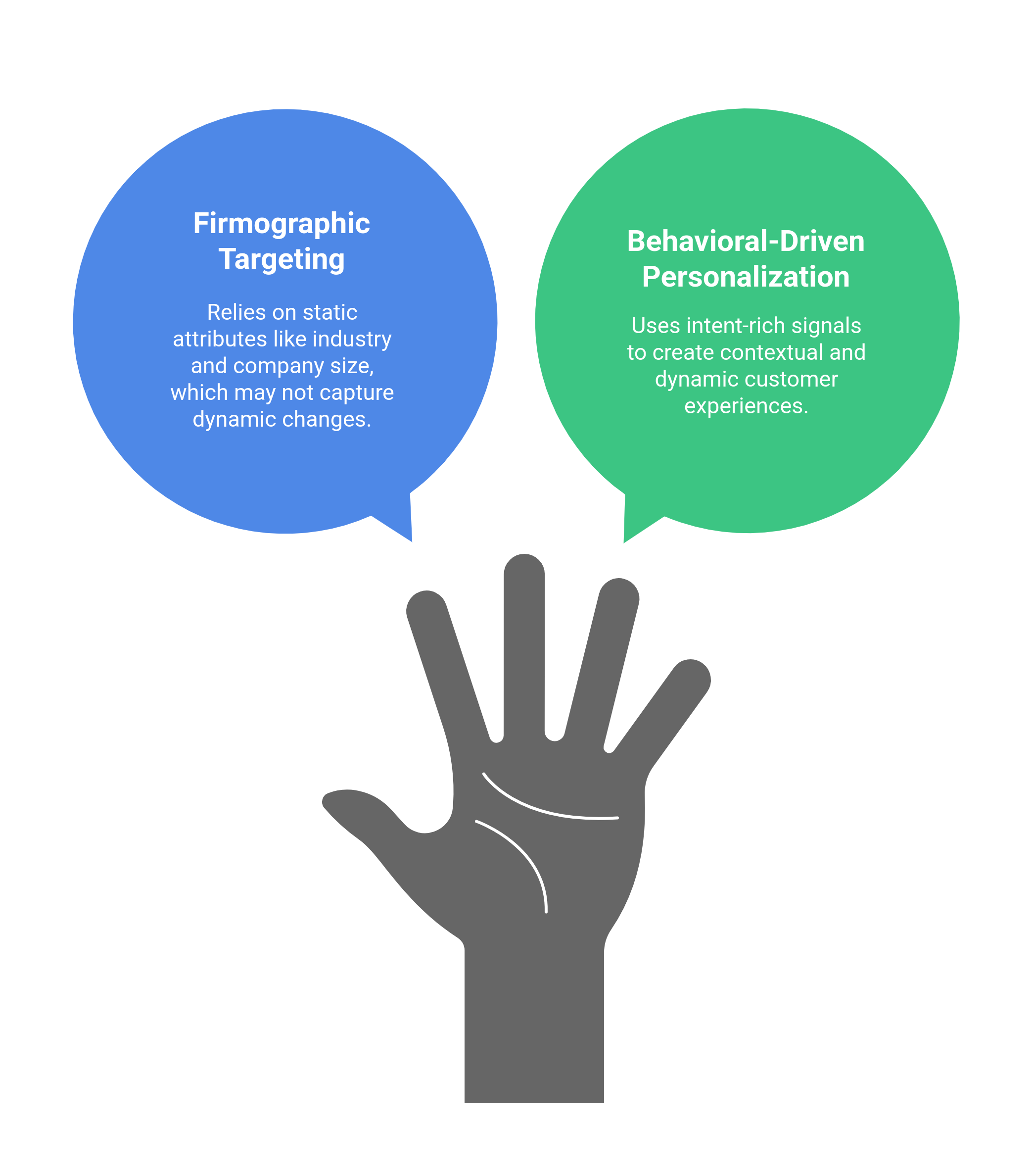
Demographic and firmographic segmentation have always been B2B marketers' old standards. Demographics (like age or role) and firmographics (like industry, company size, revenue, and location) offer a static snapshot—useful, yes, but devoid of what a buyer thinks, what they want, or when they decide to act. Such criteria could be helpful filters for targeting, but certainly cannot be fully relied upon for accurate personalization.
Behavioral segmentation, however, establishes context and timing. It not only identifies fit; it reveals intent. No longer do you merely speculate interest based on a lead's title or company name; now you can validate it based on behavior. This distinction is crucial in B2B, where numerous decision-makers might interact with your content at varied times, and personalization has to take into account the real-world nuances of a buyer's journey and not only their title.
Types of Behavioral Data That Matter in B2B
Behavioral data in B2B encompasses various touches and signals. Some of the most valuable types include:
- Website Browsing Behavior: Which pages were visited? Did this account revisit? Did it spend serious time on high-intent pages like case studies or pricing? Did it quickly bounce off our site or view multiple assets all in one session?
- Email Engagement: Are emails being opened? Are they being clicked? Or are they just being ignored altogether? Do they respond to emails even after long gaps in communication, or do they maintain engagement consistently?
- CRM Interactions: Sales calls logged in CRM, support requests, or outright responses to outreach give insights into intent and readiness. If you ask me, the history of interactions in a multi-touch buying process usually outweighs form fills.
- Content Consumption Behavior: What do they like? Do they prefer product-focused assets, executive thought leadership, or technical deep dives? Are they more prone to watching videos, downloading whitepapers, or attending webinars?
- Campaign Engagement: What are they doing in relation to ad campaigns, retargeting efforts, or nurture tracks? Repeated engagement could indicate interest, whereas a lack of interaction could indicate disinterest or misalignment.
- Product Usage Data (for existing customers or freemium users): Behavioral segmentation based on features used, frequency of login, or support activity becomes invaluable when used in conjunction with a product-led growth (PLG) model or free trials.
Each of these behaviors tells a story; in collective analysis, these behaviors allow marketers to develop a real-time awareness of where an account or stakeholder is within their journey and how to personalize the next touchpoint.
How to Collect Behavioral Data for B2B Segmentation
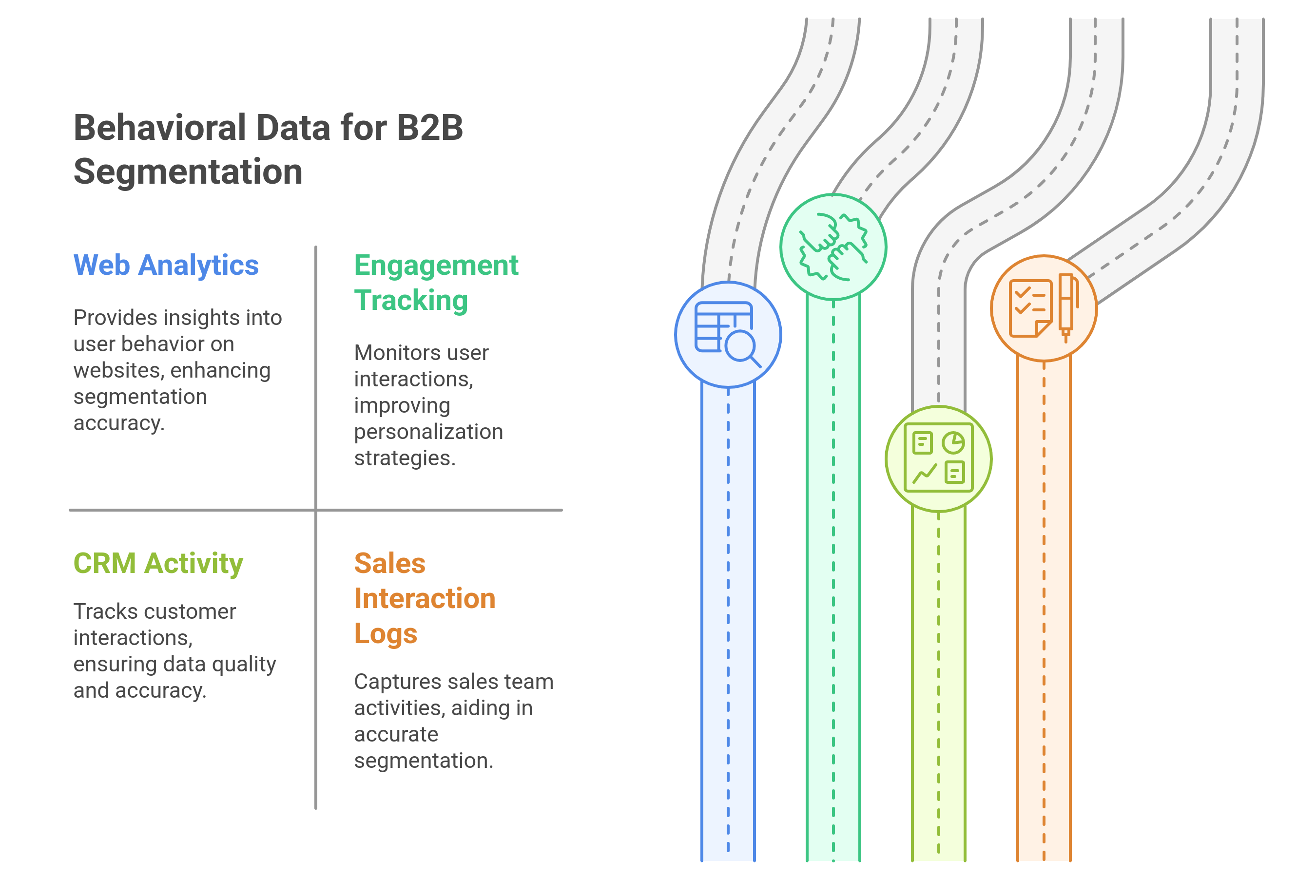
Before actually personalizing anything, there is a need for data that reflects how the audience behaves. Behavioral segmentation is as good and great as the inputs that fuel it; in the B2B world, this means all the touchpoints, which are very diverse digital as well as human interactions. Here, the section delves into core channels and systems where behavioral data is placed, besides how marketers harness and utilize it to create actionable segments. There must be a further breakdown of that rather neglected aggregate problem of data unification in very enterprise-level or stakeholder sales environments.
Website Analytics: Clicks, Time on Page, Heatmaps, and Scroll Depth
Your website is a behavioral goldmine. Every click, hover, scroll, and bounce can teach you something about the visitor's interest and intent. The standard measures of click-through rates, time on page, and pages per session indicate engagement levels, while heatmaps and scroll depth give you a more nuanced view of users' interactions with your content. For example, if a visitor scrolls down to the pricing section repeatedly or engages with highly contrasting pages of products, that is a clear behavioral signal worth segmenting on.
Tools such as Hotjar, GA, or FullStory would track this data; the touch point that brings this all together is what is truly valuable: tying those behavioral events back to known users or accounts. It is at this time that you can personalize real-time experiences, such as by surfacing case studies specific to their industry or dynamically changing CTAs based on funnel stage.
Email Activity: Open, Click, and Time to Take Action
Emails are never just about delivering content, but are also an important medium through which relevant behavioral signals are generated. Tracking open rates, click-throughs, time-to-click, and post-click behavior lets you know what topics resonate, who is going to engage, and who is falling off. For example, a case where a lead repeatedly clicks on a product update but doesn't pay attention to thought leadership would indicate a mindset of doing an evaluation of product fit, perfect for mid-funnel personalization.
Behavioral segmentation based on email engagement fits really well in such nurturing flows, giving you opportunities to customize the pace of messaging, content type, and timing of follow-ups due to actual interest, rather than following something static like a dive schedule.
CRM Activity Logs
Even some of the most behavioral thick data are in the CRM, especially those sales-led organizations. You will realize that the lead status or lifecycle stage reflected in their records do not matter. Rather, it can be found in recorded touchpoints: who responded to outreach, those who went into the dark after initial excitement over the lead; who asked for a demo; and those who forwarded internally an email. Every registered sales call, submission of a form, or reply to a conversation should be considered a behavior worth tracking.
Insights are especially used to find the hand-raisers, who exhibit signs of active intent by requesting, questioning, and downloading resources. Segmentation based on this data will increase the chances of giving priority to high-intent contacts, and better following up with them across the sales cycle.
Ad Engagement, Webinar Participation, or Download Content
Behavioral data is not an exclusive privilege of one's owned channels. Ad interaction like who clicked a LinkedIn ad for product launch might divide accounts with early interest. Webinar registration and participation indicate deeper interest in learning and often co-relate with mid-funnel or evaluation-stage behavior. Likewise, whitepaper downloads, ROI calculator use, or case study requests, are all clear signals for high intent.
Via correct capturing and tagging of such behavioral data, marketers can design strong segments- such as "webinar attendees visiting the pricing page within 7 days"- to target, retarget or lead hand off those consumers.
CDPs in the Data Unification Challenge for B2B
Data collection isn't the difficult part in B2B; data unification is. Behavior spreads across multiple tools and devices, as well as many different personas, when targeting buying committees. That's where a CDP comes in; a well-linked CDP can connect web activity, CRM events, email behavior, ad engagement, and much more into a single, unified customer or account profile.
In B2B contexts, however, challenges in behavioral data unification often involve account-level aggregation, anonymous visitor tracking, and cross-platform identity resolutions. Addressing this challenge is fundamental in segmentation. Without unification, you are left with fragmented signals and lost personalization opportunities.
Key Behavioral Segments to Use in B2B Personalization Campaigns
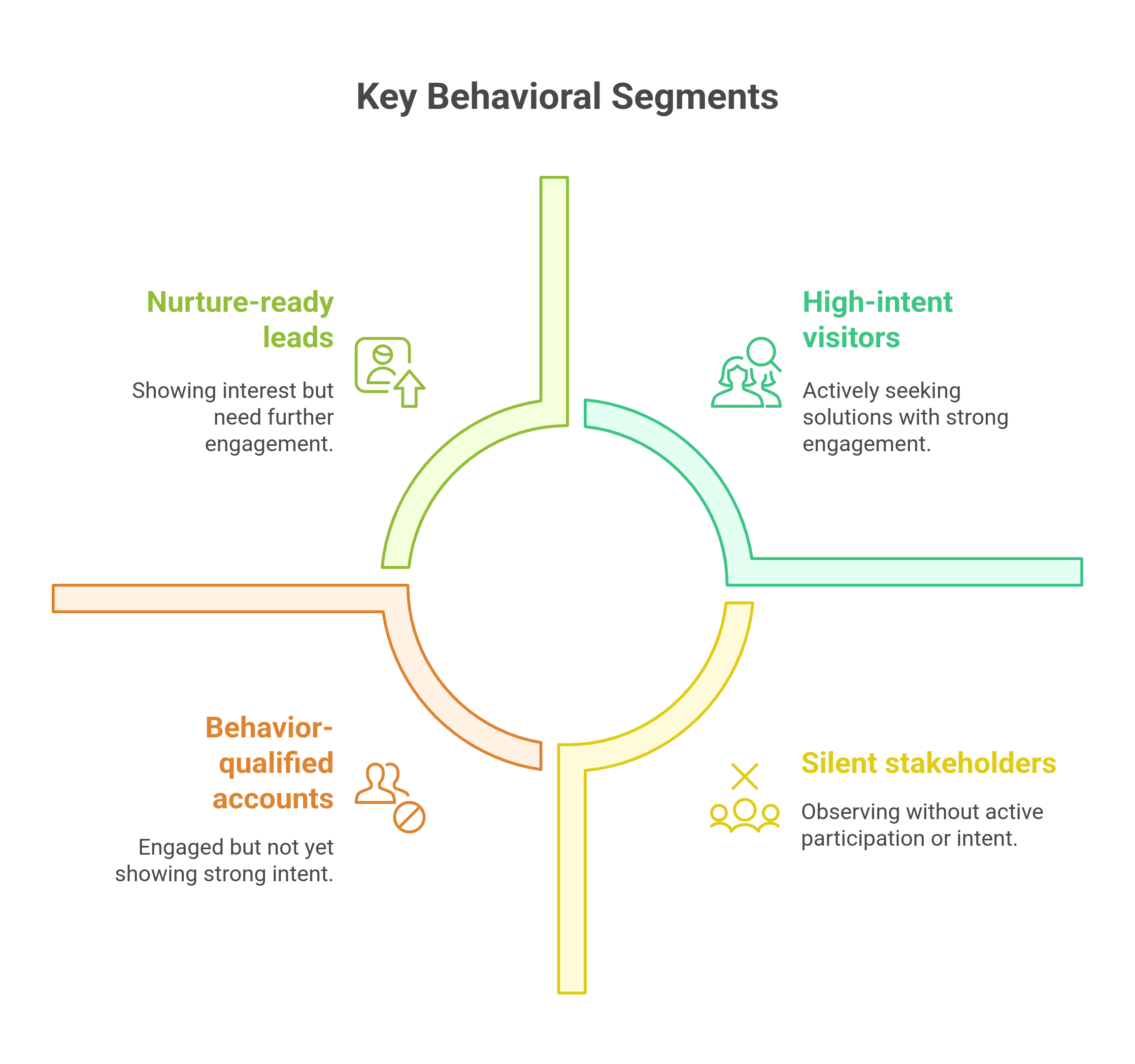
To personalize effectively in B2B, you need to segment not just by who your audience is, but how they behave. Behavioral segmentation allows you to create dynamic groups of users or accounts based on real actions—revealing their intent, engagement level, and where they are in the buying cycle. This section identifies the most impactful behavioral segment types that are utilized by high-performing B2B marketing teams. Each of those segments supplies the basis for smarter targeting, more relevant messaging, and timely personalization via your website, emails, ads, and sales outreach.
Returning Visitors vs. First-Time Visitors
After B2C, this is perhaps one of the simplest yet most impactful behavioral distinctions one can possibly make. First-time visitors normally require much more context; lightweight CTAs, trust builders like testimonials, and educational content work best here. In contrast, returning visitors typically know your brand and are re-engaging for a reason. They might be ready for a deeper offer, such as a product demonstration, industry-specific case study, or pricing breakdown.
By identifying and segmenting these audiences, you can personalize the experience accordingly—for example, showing returning visitors a different homepage hero/(different) adaptive call-to-actions reflecting their last touchpoint.
High Intention Activity (example pricing page visits/demo requests)
This action is clear proof of an individual's shopping intentions: pricing page visits, demo requests, or even product comparisons are some examples of highly intent activity that indicate that the person has actively been evaluating solutions and may soon be ready to make a decision.
From these behaviors, marketers can create segments for fast personalized approaches such as handing a lead over to sales, BOFU content, or extreme targeted email follow-ups. This is the kind of prospect that should be treated differently from just any other prospect-they are ready for tailored value conversations.
Stage-The-Funnel Activity TOFU, MOFU, and BOFU Behavioral Distinctions:
This is why behavioral segmentation is important: to map users across to the right stage of the funnel:
- TOFU: This includes reading blog articles, attending webinars, or downloading guides; the main goal is to serve these individuals educational content, minus much problem awareness.
- MOFU: Middle of the Funnel, engaging in product pages, comparison content, or use case stories, are prime candidates for nurturing with social proof and case studies.
- A BOFU behavior includes demo request submissions, return visits to pricing, or strong involvement with the sales department our opinion, the perfect ground to proceed with 1:1 follow-up and direct conversion CTAs.
Segmenting according to the funnel stage ensures that you are not serving product-heavy content to someone just learning about the problem-or general thought leadership to someone already evaluating your solution.
Frequency and Recency of Interaction
The frequency and recency of a person's interaction with a brand usually reveal a lot about that person's intensity of engagement. If a prospect visits the site every day, for example, or downloads a series of assets in one week, they are far more engaged than a prospect who comes once every few months. Keep in mind that a person who engaged yesterday will most likely have a higher opportunity to be converted than one who interacted some months ago.
Using recency (R) and frequency (F) segmentation, you will be able to devise a simple and yet efficient model for prioritizing outreach, personalizing nurture strategies, and adjusting the timing of retargeting or email cadences.
Behavior-Based Lead Scoring Segmentation
Lead scoring does not have to be limited to static information. Based on behavior, lead scoring gives point values to high-value actions, such as watching a full product video, clicking through on key nurturing emails, or attending a webinar, bucketed together in such segments as "marketing qualified," "sales ready," or "early-stage nurture."
Behavioral lead scoring segments are particularly useful for automation-triggering sales alerts, customizing nurture tracks, or pushing high-scoring leads into your SDR team. Also, this is derived from the actual actions of people instead of just profile data, making it more predictive in terms of conversion potential.
Multi-Stakeholder Account Activity Patterns
In B2B, the decision-making process very rarely involves one person. Therefore, it is essential to track and segment account-level behavior rather than direct behavior. For example, if three different people from the same company attend your webinar, and one goes on to check the pricing page after that, this can be a signal for an activated buying group.
With stakeholder behavior data aggregated across the same account, you can identify and segment the following:
- Accounts that exhibit increasing engagement signals
- Dormant accounts since their engagement has tapered off
- Accounts where there are multiple personas active across different positions and channels
This will allow for true account-based personalization, whereby your messaging is in sync with the behavior of the entire buying team as opposed to the behavior of a single contact.
How Behavioral Segmentation Improves Personalization of B2B Marketing
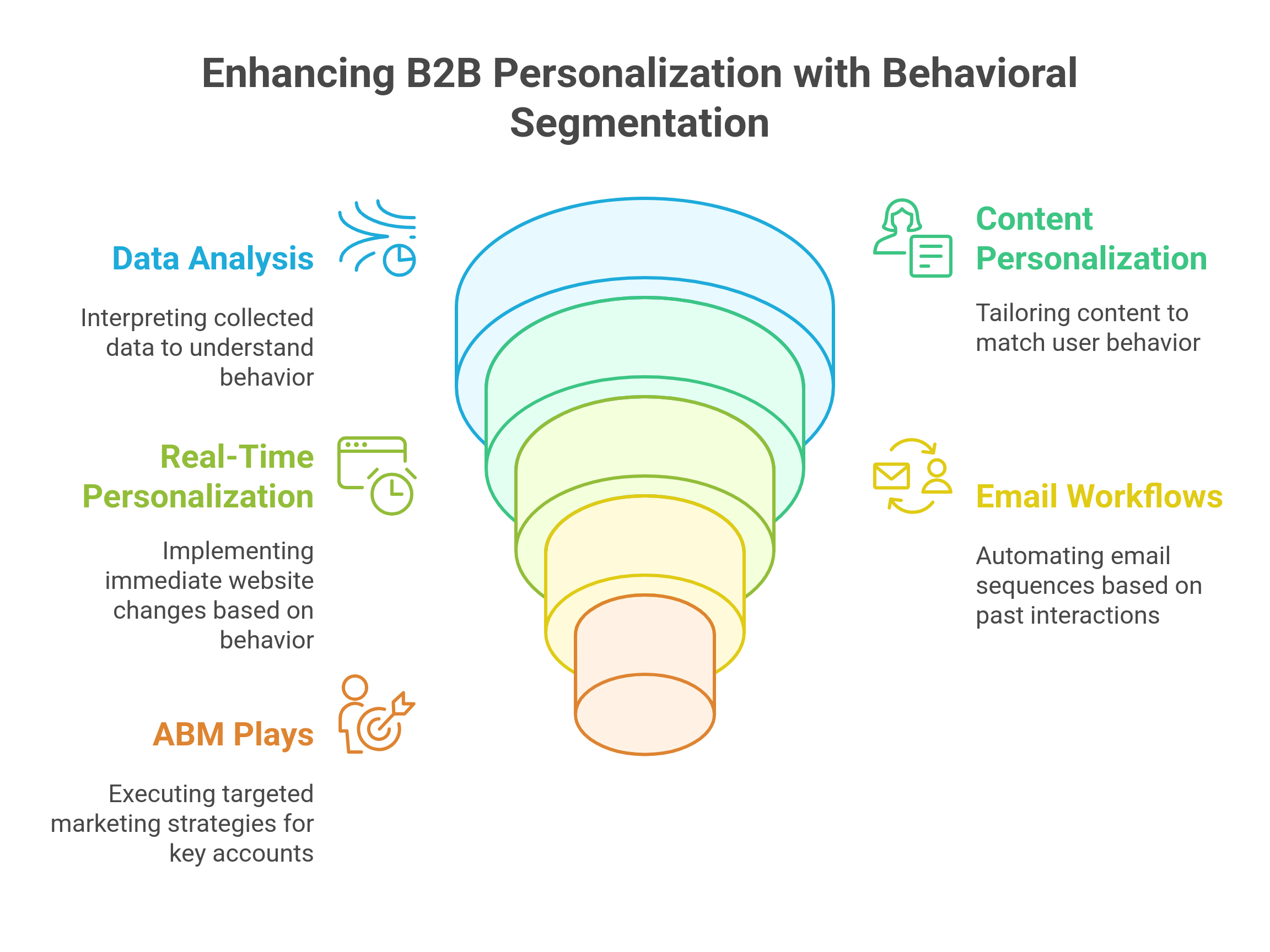
Behavioral segmentation is a method that creates the engine for a meaningful, relevant, and conversion-driving personalization in B2B marketing. In this section, we shall discuss how behavioral data leads to smart decisions, timely interactions, and ultimately better results from the pipeline. From generalized targeting to contextual engagement, behavior should determine what you say, when you say it, and to whom.
Enables Personalization in Real-time of Purchase Intent
Behavioral segmentation, typically, allows experience personalization in its unfolding process. For example, someone records a second visit to the "pricing" page on your site during one week. That new visit can easily trigger the callout writing, "Let's talk pricing for your use case," or initiate a live chat session. The immediate nature of real-time interactions enhances their relevance, and this increased relevance positively impacts conversion rates. The real-time behavioral signals give you a peek into intent, where static data just can't do it. Behavioral segmentation is no longer the catch-all for deprivation of pre-positioned nurture tracks or assumptions based on a visitor's job title, but instead allows you to serve the content, right here at the right time, dependent solely upon what the prospect is interested in at that moment.
Provides Contextual Relevance Across Touchpoints
B2B personalization is often unsuccessful due to the fact that they tend to treat all prospects with equal contempt or use personalized salutations as sprinkles on general-purpose content. Behavioral segmentation takes all of that into account and provides context—what the person or account has recently done, seen, interacted with, or responded to. That context allows you to customize not just the message but the offer itself, as well as the tone and delivery mechanism. For example, a CTO who downloaded your security whitepaper might get an email follow-up that puts a spotlight on compliance case studies. Meanwhile, a marketing lead from that same company watching a product demo might see retargeting ads for campaign automation. Same account, different behaviors, each driving their own highly customized experiences.
Improves Lead Qualification and Sales Handoff Accuracy
Behavioral segmentation has the power to pull marketing and sales into alignment. It helps identify sales-ready leads based on high-intention behaviors, such as demo requests, repeated visits to the pricing page, or attendance at multiple webinars. More importantly, you can contextualize behavioral activity for the sales team: what the lead read, clicked on, downloaded, or dismissed. Therefore, these insights improve the quality of handoffs and allow reps to personalize follow-ups based on real lead behavior rather than job titles. Instead of cold outreach, reps can say: "I saw you were comparing our solutions to X—I'm happy to walk you through what's different." This behavioral insight transforms generic pitches into meaningful dialogues.
Supports an Adaptive Journey Mapping and Funnel Acceleration
Each buying journey is entirely different from the other, especially in B2B, where decisions are non-linear and multithreaded. On-the-fly journey rendition based on behavior allows you to route prospects into entirely different nurture tracks, campaign flows, and retargeting lists as determined by their contextual engagement. For instance, showing such BOFU behavior early, such as asking for a product sheet right after downloading, should get them on their fast track to sales sequences. By contrast, up-funnel prospects should be nurtured with directions quite independently concerning educational content. An adaptive journey design developed around contextual behavior creates a more seamless, faster experience, and the velocity required in the pipe.
Enhances Accuracy for ABM
Behavioral segmentation, once you take it down to the account level, greatly enhances ABM efforts. One can now identify and tailor for specific interests around a buying group inside a target account. The earliest engagement signal across multiple departments pinpoints the target account for a multipronged attack. This is the early discovery of customer friction: collective behaviors within an account. This information feeds ultraprecision ABM; think personalized landing pages based on vertical behavior, specific sales sequences aimed at stakeholder needs, and budget-conscious retargeting aimed only at accounts with recent meaningful activity.
Bridges the Gap between Marketing Actions and Buyer Readiness
At the end of the day, behavioral segmentation closes the gap between what you want buyers to do and what they are actually ready for. Instead of hammering all your prospects with the exact same message, you listen first and start to speak in response to what you hear. That gives buyers a feeling of being understood, which is a rare commodity wielding extraordinary power in today's B2B landscape. Behaviors that are observed-silent signals like second visits, time spent on a product page, and rewatching a recorded webinar-can personalize empathetic and precise marketing. That not only constitutes smart marketing, but it is the premise of trust formation during the B2B decision process.
Examples of Behavioral Segmentation
There is a lot of theoretical talk about behavioral segmentation, but one wonders how this actually works in the real world. Here we shall survey real B2B brands that use behavioral segmentation in smart and strategic ways so as to personalize web experiences, improve lead nurturing, quicken an opportunity's velocity, and optimize account-based marketing. Hence, examples demonstrating behavioral insights have a role to play in making B2B journeys, even those that are complex and involve multiple stakeholders, very personal.
HubSpot
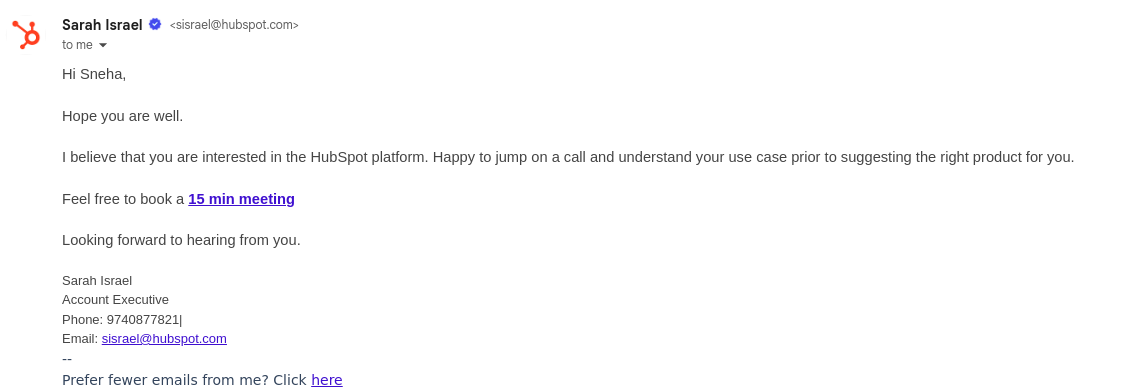
The behavioral signs are strong correlates of their email nurture flows within HubSpot. For instance, if a lead downloads a TOFU eBook and clicks on a product video link within 48 hours of doing so, the lead falls into a mid-funnel track where the nurturing includes case studies and competitor comparison guides. Leads that open email messages as a habitual occurrence, but do not click on any of the links therein, have also been segmented into the low engagement subgroup. Instead of adding nurturing content, low engagement leads can simply receive lighter-touch content or be re-engaged through a different channel, such as advertisements, thereby ensuring that nurturing is truly tailored according to current readiness and interest level.
Netflix
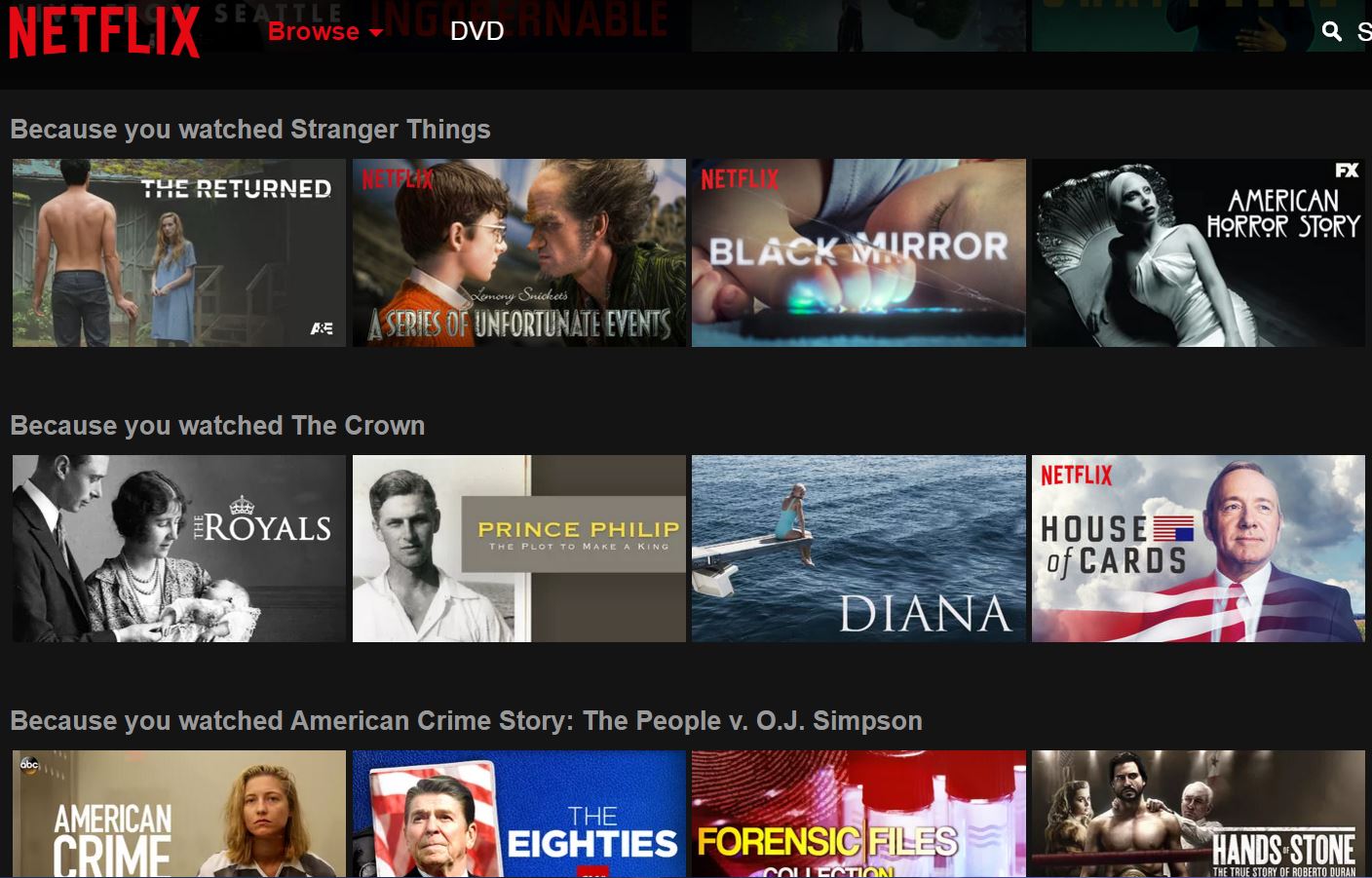
Netflix segments not only based on what type of genres the users refer to but also considers so many other things, including time spent watching, navigation patterns, pause points, replays, skips, and binge patterns. It uses this behavioral data to create micro-segments and deliver hyper-specific content recommendations; for example, Crime documentary bingers. International drama samplers. Users who pause often when they reach the end but don't finish the episode. The platform would change almost every thumbnail image based on what most resonates in a user's past behavior.
B2B takeaway: You do not have to be able to offer a video streaming service before learning from this example. If a visitor keeps coming back to your B2B web site to view case studies in a specific industry or quite frequently watches how-to videos of your products, such behavioral segmentation will allow you to bring the relevant content and CTAs up to such an interest-for example, a return visit could show a case study carousel or dynamically insert certain industry-specific words into page copy.
Spotify
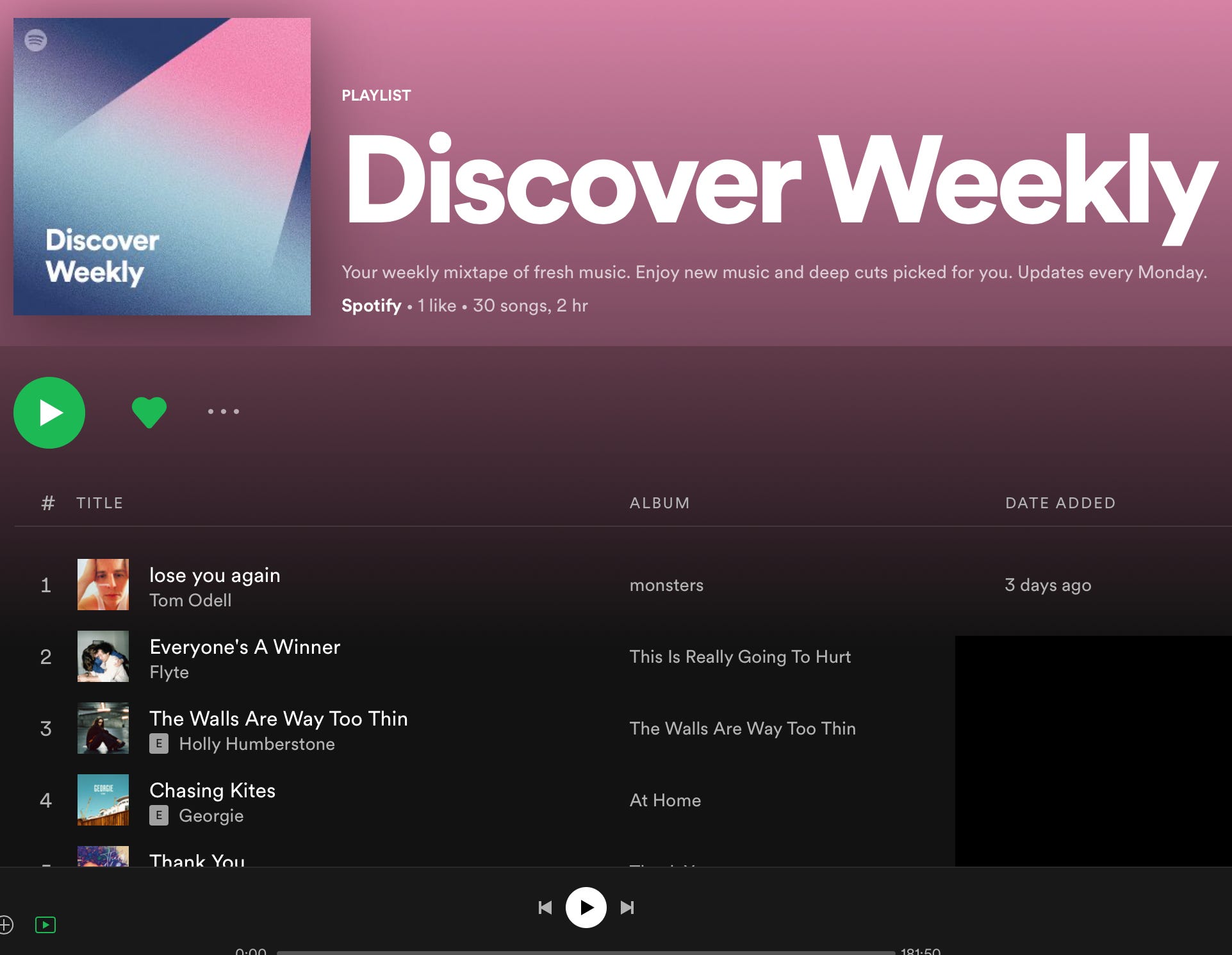
Spotify constructs all its campaigns, for example, Discover Weekly and Wrapped, on different user behavior patterns such as listening frequency, track skipping, the number of playlists created, and even the time of day. Rather, they are experiences that are designed following an intelligent segregation logic. Thus, the behavioral engine recognizes not only what people have listened to, but also how they were engaged with that content-and thus predicts what content they will love next.
For example, B2B: Tracking which kinds of content-the product pages, webinars, or ROI calculators-are engaged with most often and when could then tailor dynamic nurture flows or retargeting campaigns to those windows. Resources can then be recommended much like Spotify's predictive playlists-for marketers who can make B2B marketing feel so much more intuitive, personal, and time-delivered based on behavior rather than guesswork.
How to Activate Behavioral Segments Throughout the Marketing Stack
Once you've built behavioral segments, the magic is in activating them across the entire marketing ecosystem. That means making your website, emails, CRM, ad campaigns, and sales handovers smarter and more responsive to how each lead or account is acting in real-time. This section lays out in detail how to do just that, with concrete steps and examples that any B2B team can follow, regardless of their tech stack size.
Step 1: Build and Sync Behavioral Segments in a Customer Data Platform (CDP)
In this first step, we create dynamic behavioral segments inside the Customer Data Platform that aggregate activity across channels: website, CRM, emails, ad platforms, and more. These platforms allow you to define audience rules based on things like page views, asset downloads, session frequency, or key touchpoints. Once these are defined, these segments ought to be synced with downstream tools--whether that's your marketing automation platform, CRM, or personalization layers. The whole idea is centralization: One source of behavioral truth flows into every activation point.
Examples of behavioral segments you can build:
- Leads who have viewed the pricing page more than twice within the last 7 days.
- Contacts who have opened 3+ emails and have clicked at least once;
- Accounts with multiple stakeholders attending different webinars;
- Users who have interacted with 2+ bottom-funnel resources in a week's time.
Step 2: Initiate Dynamic Personalized Email Campaigns Based on Behaviors
Get your segments rolling to start using them for automating behavior-based triggered emails. These can be part of nurture sequences or standalone campaigns that react instantaneously to specific actions, for example, viewing a page with a high intent or filling out a form and then abandoning it. Behavioral triggers have been found to work better than the traditional drip campaigns because they are built on contextual timing, not guesswork. The email tool should allow for the mapping of specific behaviors to their corresponding flows of emails and offer the possibility of personalizing subject lines, body content, and CTAs according to the consumer's behavioral qualities.
Example Triggered Email Flows:
- Downloaded a product guide → Case study follow-up email in the same industry
- Attended a product webinar → Email offering a tailored demo
- View comparison page twice → Send competitor battlecard or pricing breakdown
- Engaged heavily with product-focused content → Trigger SDR outreach via email with a soft CTA.
Step 3: Deliver Dynamic Website Content for each Behavioral Segment
Behavioral segmentation prevents your website from static formality and makes it quite similar to a savvy digital sales agent. You can personalize homepage CTAs, messaging blocks, case study placements, or even chatbot scripts based on the user's prior activities. Tools like Fragmatic, or Adobe Target allow you to define experience rules by segment-so visitors see the content that aligns with where they are in their journey, not just who they are demographically or firmographically.
Examples of real-time website personalization:
- Returning visitor who downloaded a whitepaper sees a hero CTA: "Let's Talk ROI: Book a Custom Demo"
- First-time visitor exploring early-stage blogs sees: "Browse Our Resource Library with No Cost"
- A known account from the finance industry includes industry-specific testimonials and customer logos.
- High-intent segment user is shown a chatbot prompt: "Still deciding? I can help compare plans."
Step 4: Use Behavioral Segmentation for Sales Outreach
Sales teams should not go blind, and behavioral segmentation will allow reps to actually tailor outreach based on what prospects have already done and not who they are. Tying various behavior-based insight points to the CRM (like content consumed or sessions logged, for example) empowers your sales team to focus attention on warm leads, not only customizing messaging but also making sales enablement proactive and intrusive, with automated triggers that tell reps when buying signals appear.
Examples of sales activations using behavioral segments:
- Notified by SDR when a lead watches a video demo twice in 48 hours
- CRM surfaces a "hot" behavior score derived from several visits to the pricing page.
- AE gets a daily listing of accounts where 3 or more individuals interacted with mid-funnel content
- Sales rep individualized intro email according to the last attended webinar of the prospect
Step 5: Fuel the Retargeting Ads with Behavioral Intelligence
Don't serve the same generic ad to all those visiting your site. Instead, push your behavioral segments to the ad platforms—LinkedIn, Google Ads, or Meta—and finally run hyper-targeted retargeting campaigns. Behavioral signals allow you to define who is really showing intent, what message they should see, and where they are in the buying cycle. This improves ROAS and makes for an overall better cross-channel experience.
Examples of behaviorally targeted ads:
- Visitor who viewed pricing page but didn't convert → Ad with "Talk to Sales" CTA.
- Research-phase prospect who reads top-of-funnel blogs → Ad for in-depth guide.
- Webinar registrants who missed the session → Ad with Access to the recording and next steps.
- Accounts engaged by multiple users → ABM-style ad with social proof and industry-specific messaging
Best Practices for Activating Behavioral Segments Across Channels
Getting the most from behavioral segments across channels comes through activation for all segments, not just in silos. Personalization resides in aligning behavior-based insights across every touchpoint: website, email, ads, and even outbound outreach. This section walks through channel-by-channel best practices that ensure your segments aren't just smart but strategically connected across the customer journey.
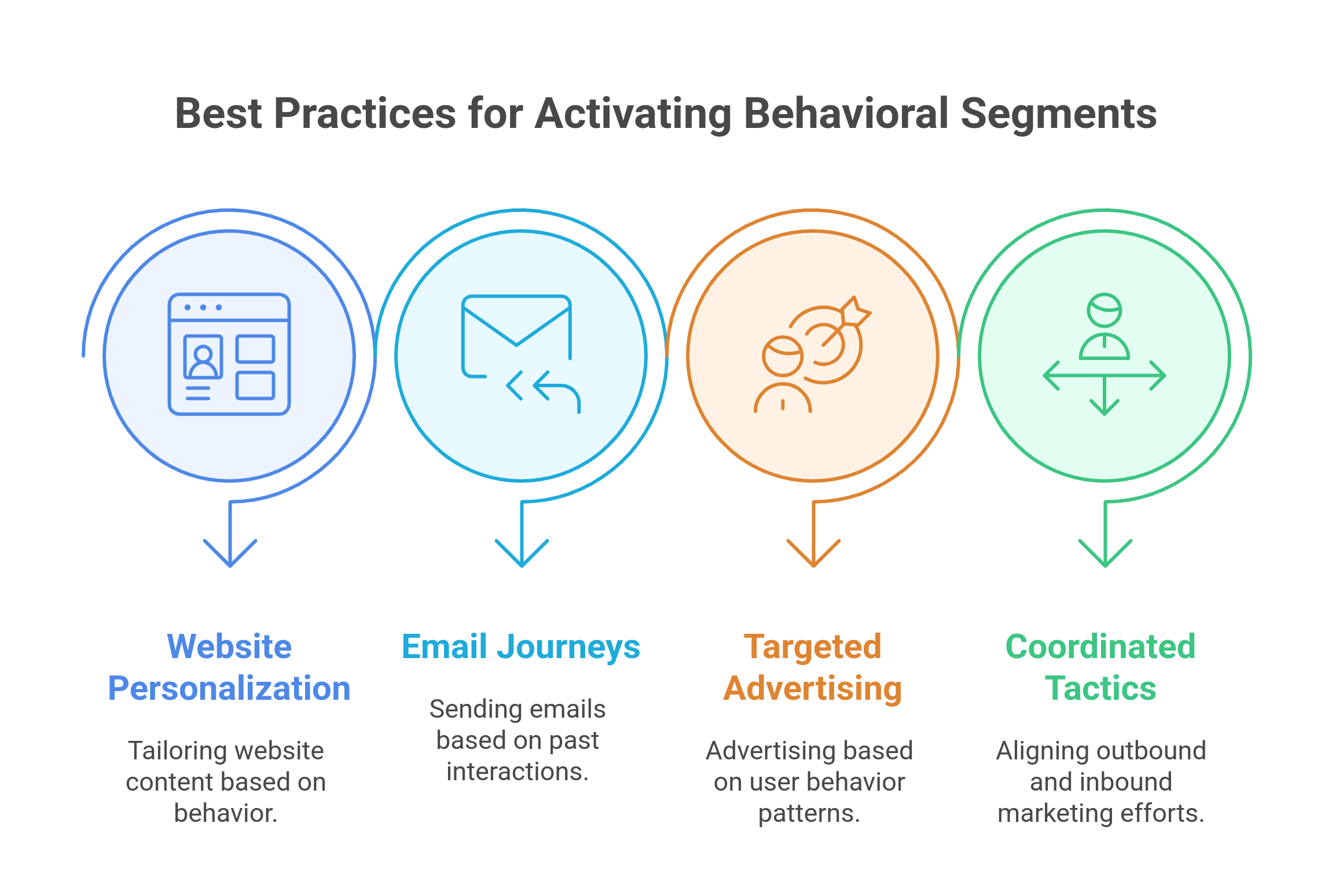
Using Behavioral Insights for Website Personalization
A website should behave like a smart concierge, responding to the previous actions of visitors, not merely serving as a static brochure. Use behavior-based segments to personalize everything-from home page messages to CTAs and recommended content. Focus on relevance: show returning visitors something they haven't seen and guide high-intent visitors to decision-making actions. Dynamic display (by session history, asset engagement, and depth of interaction) changes what a user sees. Examples:
Visitors who downloaded a product guide now see a message on the home page offering a demo.
First-time visitors from a particular industry see specific use cases and case studies tailored for them.
Users who linger on the ROI calculator receive a customized banner that drives them to an overview of the business value proposition.
Behavior-Driven Advertising and Retargeting
One shoe does not fit all when it comes to retargeting. Using behavioral segments creates custom ad audiences, reflecting intent and stages of decision-making as well as content preferences. Push these segments from your CDP or web analytics platform into Google Ads, LinkedIn, or Meta. Then change the creative based on behavioral insights, not just who the user is. Illustrations:
Ads promoting "Get a Custom Quote" are given to visitors who looked at the pricing page but did not convert.
Prospects who have gone through many top-of-funnel blogs receive ads promoting the gated industry report.
Accounts with multiple visits from key personas are included in a coordinated ABM campaign with industry evidence and testimonials.
Email Journeys Echoing Historic Engagement
Email automation should never be robotic or one-size-fits-all. Bring behaviorally-triggering email journeys, such as downloading, page visiting, webinars, and other things, into conditional logic in your workflows. Avoid creating repeated emails by excluding or adjusting based on what the user has already interacted with. This not only gives the impression that someone is really listening but also heightens the relevance at each point in the engagement. Examples:
By not receiving the general product overview email, a lead who already viewed the demo gets straight to the pricing-focused content.
Webinar absentees will receive a follow-up email with the link to the recording and more resources.
Contacts who open three or more product-focused emails seamlessly enter a sales-qualified lead nurturing path.
Aligning Outbound and Inbound Initiatives by Using the Same Segments
Outbound and inbound marketing efforts can achieve a multiplying effect when they speak the same behavioral "language." Behavioral segments for the two functions should be kept consistent so that SDRs and marketers reinforce rather than duplicate their efforts and avoid disjointed experiences. Behavioral data can be used for timing, messaging, and even the channel an outbound communication uses: email, LinkedIn, or phone. Examples:
A contact downloading content related to pricing triggers a marketing email and an alert to the SDR for quote-focused outreach.
Account has multiple personas engaging in various types of content, marketing continues nurturing by role, while sales initiates a multi-threaded approach.
Behavioral cold-to-warm transitions, like after a webinar engagement, are flagged so outbound reps can jump in with timely value-driven messages.
Conclusion
In the relevance race, B2B marketers unduly commit to firmographics or static personas, thereby ignoring the dynamic signals that actually speak to buying intent. Behavioral segmentation covers this missing layer. It converts passive interactions into actionable insights, allowing you to personalize with precision from the top to the bottom of the funnel.
By aligning behavior with buyer needs, activating segments across tools, and customizing each touchpoint, you build a marketing experience that adjusts in real-time, not just in reaction. This is not merely a personalization tactic; it is a competitive advantage. The deeper the relevant B2B buyers want, the less friction they can handle. Those marketers who embrace behavioral segmentation will drive engagement, shorten conversions, and create stronger customer relationships. No more guessing; listen to what your prospects are saying based on their behavior.


