

Introduction
The inbox may seem like an ordinary space in the digital realm, yet it is governed by some of the most stringent email compliance regulations in today's marketing world. The evolving email regulations have ceased to be merely a hard-and-fast legal requirement; compliance with them is now being hailed as a core business strategy as brands become data-driven and global. By the time we hit 2025, due to new privacy expectations and tightening enforcement globally, much more than nice copy and strong CTAs will be required for your emails—an unbreakable insight into email compliance regulations is going to be mandatory.
Today, consumers are the most alert. They know of misuse when it comes to their data and are not afraid to report or cut any form of association. Governments are accordingly responding with stronger email marketing laws and data privacy laws that will require transparency, along with consent and accountability by the sender. Be it caring for B2B leads or running high-volume promotional campaigns, one mistake in maintaining email compliance can mean financial penalties, poor deliverability, and, more importantly, the loss of customer trust.
The intention of this blog is to detail what one needs to know about email compliance in 2025. From a broad overview of the global email regulations landscape to what you should understand that makes your email campaigns legally sound, we will introduce you to all must-know components, legal implications, and best practices of keeping your communications compliant and your brand protected.
What is Email Compliance?
Email compliance refers to the set of rules and standards that govern how businesses can legally and ethically use email to communicate with their audience. These rules exist to protect recipients from spam, misleading content, violations of their privacy, and unsolicited marketing. At the heart of email compliance is the assurance that every message sent adheres to the principles of consent, clear opt-out options, and transparent communication about data usage—primary requirements in most email compliance laws internationally.
Whether you are conducting a newsletter, promotional activity, or any sort of automated onboarding program, email compliance achieves its purpose by protecting the credibility of your brand with the audience, high deliverability rates of such emails, and building long-term trust with your audience.
Evolution of Email Compliance
The first email regulations were born in 2003 with the CAN-SPAM Act in the United States. This fundamental law required that emails unambiguously provide for unsubscribe options and not deceive customers in the wording of the subject lines. Since then, we have heard better regulations for the practice, like GDPR in Europe and CASL in Canada. These regulations moved from mere opt-out mechanisms to verifiable, auditable consent.
In 2025, the evolution of email is going to be more interesting. Digital marketing environments are now fast embracing AI-generated content, behavior-based personalization, and biometric tracking. In this context, regulators are also developing email-compliance-specific laws that will bring about a new world of rules focusing on fairness, transparency, and accountability of algorithms in collecting, processing, and using data to trigger email campaigns.
Key Pillars of Email Compliance
Modern email compliance rests on four fundamental elements:
- Consent: You must have a legal basis to contact someone, such as an opt-in or explicit permission. Consent must be informed, given freely, and documented.
- Data Usage Transparency: Users should be informed how their data will be used, whether that be for personalization, analytics, or sharing with third parties, thus aligning with the emerging data privacy laws on minimizing such misuse.
- Unsubscribe Mechanism: Each commercial email must provide a working unsubscribe mechanism that is clear to the recipients, ideally in one click and quickly honored. Making it hard to unsubscribe will undoubtedly lead to complaints.
- Clear and Honest Content: Subject lines that mislead, an urgency that is fake, or ads concealed under a disguise are all things prohibited by email marketing laws. Honesty is the way of life, and it is also a law.
The Shift Toward User-Centric Email Practices
What had once been an afterthought for legal teams is now becoming a center stage in brand experience. In 2025, email compliance will not be about avoiding hefty fines; it will be about delivering pertinent, respectful communications that put the user at the centre of influence. Such a shift takes into account an even bigger trend of user-centric data management, balancing personalization against consent and transparency. In the end, email compliance will not just ensure good governance-it will actually be good marketing. Users interact more with brands they trust. Trust is built when recipients deem their inbox worthy of integrity.
Why Email Compliance Matters?
As e-mail compliance grows into a full-blown strategy, rather than just a checkbox mechanism, in an increasingly regulated and privacy-conscious world, this section discusses why it is important not only to ensure that propriety has been sought by email compliance regulations but also to forge long-lasting relationships, encourage deliverability, and act in good faith in a data-privacy-law-polluted digital economy.
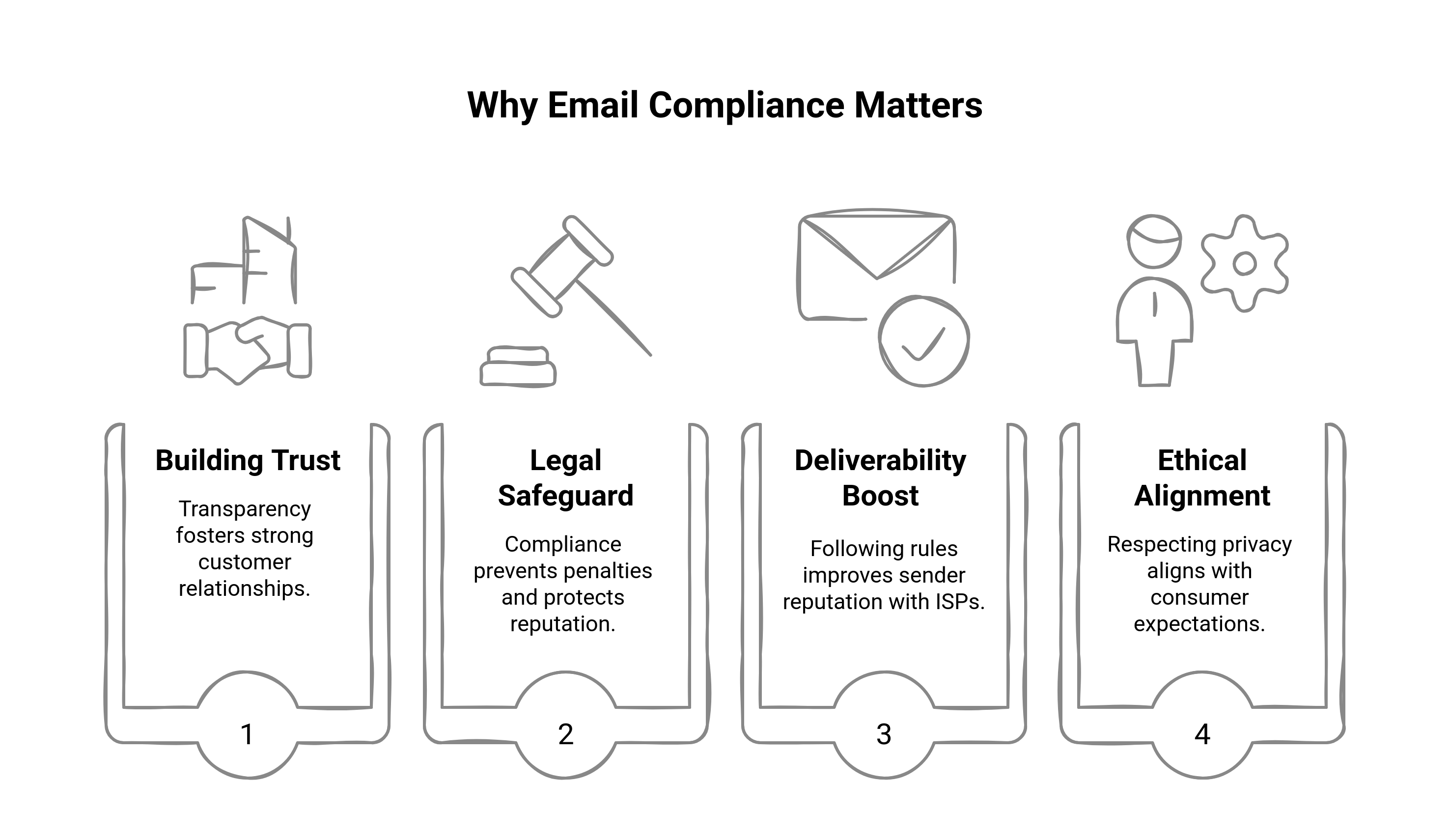
Trust equals currency
In 2025, consumers expect to know who contacted them, why they were contacted, and what will be done with their personal data. By adhering to email compliance regulations such as securing express consent and honoring opt-outs, your brand upholds these expectations. After all, one builds trust not through copy and design but through compliant behavior. When users see you respecting their inboxes and privacy, they will be more engaged, converting, and becoming loyal over time. In other words, email compliance builds revenue-sustaining trust.
Legal Protection
Serious repercussions may follow from breaking email marketing laws. Some brands have faced multimillion-dollar fines under GDPR, CAN-SPAM, and CASL for crimes ranging from sending unsolicited email to refusing to provide a working unsubscribe link. In addition to fines, breaches can result in lawsuits, investigations, and a loss of reputation. 2025 is the year when data privacy laws will start extending to AI-based personalization and automated email workflows; therefore, compliance is no longer an option but a compulsion. Complying will ensure that your company is safeguarded against legal action while avoiding consequences for your marketing.
Deliverability & Reputation
The first factor affecting inbox placement is sender reputation, and the compliance regulation ordinarily governs this reputation. The ISPs (Gmail, Outlook, Yahoo, etc.) are famous for punishing all those senders who tend to ignore the best practices of email marketing, especially spam complaints and sending to purchased lists. A sender who fully complies tends to have higher rates of engagement, better inbox placement, and rejects the use of misleading tactics to gain consent. Thus, in a nutshell, following email regulations results in great deliverability!
Ethical Marketing in a Privacy-First World
Today, consumers expect that marketing promotes and imparts ethical practices. Not just the letter of the email regulations, but the spirit behind them. This aligns your strategy with the evolution of data privacy laws, making it evident to users that you care about their autonomy, preferences, and personal data. Not only does your brand reputation become stronger, but it also helps prepare the grounds for personalized, value-driven engagement done rightly.
The Components of Email Compliance
Learning the fundamentals of email compliance. Any business that uses email either as a marketing or engagement channel needs to understand that these basic components are not just legal requirements in some of the email compliance laws, but additionally, trust-building mechanisms for strengthening a brand's credibility in this privacy-first world.

Consent & Opt-in Protocols
Explicit vs Implicit Consent: The foundation of modern email compliance really is consent; under all email marketing laws, especially GDPR and CASL, explicit consent has to be given before sending out a marketing email. Meaning that the user has taken clear, affirmative action (like ticking a checkbox) to consent to receiving communications.
In most data privacy laws, implicit consent, such as putting someone on a list after a purchase or signing up on a contact form without a clear opt-in, is no longer sufficient. Things that might have passed the test five years ago could end up putting you in non-compliance today.
Double Opt-In and Recordkeeping: Calling that User makes them double-opted with a follow-up mail confirming that the user subscribed to that specific mailing, which in actuality is one of the best ways to comply and have the least number of complaints due to spam. If you ever face an audit or legal inquiry of sorts, your very strong recordkeeping will help you out in this.
Unsubscribe Mechanisms
Clear, accessible, and immediate unsubscribe functionality is a non-negotiable under virtually all email compliance laws. Whether you're governed by CAN-SPAM, GDPR, or PECR, users must be able to opt out of marketing emails easily and without unnecessary hurdles. That means no hidden unsubscribe links, no logging in to unsubscribe, and no delays in processing the request. Respecting opt-outs is not only a legal requirement but a trust signal that shows your brand values user choice.
Sender Identification
Transparency begins with information pertaining to the sender. As per major email marketing laws, every communication sent must accurately identify the party from whom it emanates. Thus:
An appropriately recognizable “From” name
An address where reply emails can be sent as valid
The name and physical mailing address of the company (usually in the footer of the mail)
The use of names that are deceptive or anonymous increases the probability of your mail landing in the spam box while violating other email compliance regulations.
Content Rules
Subject Lines Must Not Be Misleading: Subject lines are the first- and sometimes only-thing that recipients see. Federal regulations ban subject lines that are misleading, exaggerated, or clickbait-style. Deceiving users to achieve a higher open rate may bring regulatory fines and tarnish your reputation.
Explicit Mention of Purpose for Data Usage: Your email content should also be truthful regarding how user data is applied. Do you personalize content based on previous interactions? Use behavioral tracking? Cross-share lists with partners? Make these practices explicit and, where required by law, provide a link to your privacy policy or to your data usage statement.
Data Protection
Your responsibility does not end the moment the email goes out. Under global data privacy laws, your requirement is to responsibly store, process, and secure user data. This includes:
Encryption at rest and in transit
Access controls for distribution lists
Secure integration with your CRM or ESP
A data breach requiring subscriber information—specifically with nothing in place to safeguard it—may get you into some serious trouble under regulations such as GDPR or CPRA.
Retention and Deletion Policies
The indefinite retention of subscriber data is no longer compliant with emerging email compliance regulations. It is thus your duty to formulate internal policies consisting of:
How long any inactive or unsubscribed contacts remain in your system?
When and how will data be either anonymized or deleted?
The user’s right to request deletion (where applicable)
When a retention management strategy is aligned with relevant email compliance laws, it minimizes risk and is another demonstration of respecting user privacy preferences.
Legal Implications for Non-compliance
Failing to adhere to email compliance regulations isn’t just a technical misstep—it can have serious legal, financial, and reputational consequences. Ignoring opt-outs, sending unsolicited messages, or mishandling subscriber data are just a few of the growing risks associated with not complying. This section will define some of these legal and operational dilemmas brands may face with a variety of email compliance laws and data privacy laws in 2025.

Penalties in Finance
Global regulators have, indeed, tightened the noose on contraventions of email marketing laws like never before. The financial penalties for noncompliance can be as follows:
Under the GDPR, it's possible to impose fines of up to €20 million or 4% of the annual global turnover, whichever is higher.
The U.S. CAN-SPAM acts as a deterrent from noncompliance, with penalties of up to $51,744 for every email sent in violation.
There is no doubt that CASL in Canada is known for imposing heavy fines, as it provides penalties of up to $10 million CAD for corporations.
These penalties are not mere theoretical ramifications, but rather apply on an everyday basis, especially with non-compliance with user consent and/or failures in providing proper unsubscribe mechanisms.
Extreme Criminal Liability
Civil penalties would apply for most violations, but in extreme cases, such as fraudulent phishing campaigns, intentional data misuse, or repeated, blatant non-compliance, some data privacy laws may also extend criminal consequences. Executives and marketers knowingly participating in deceptive email practices risk lawsuits or, in rare cases, even imprisonment. Fines associated with the misuse of very sensitive personal data, minors, or data used across borders are likely to receive even stricter scrutiny in 2025. Their existence and those investigations are planned to go beyond the marketing department—the cybersecurity and legal teams may take an interest as well.
Loss of Sender Reputation and Deliverability
Even if you sidestep fines, your sender reputation can be badly damaged by your disallowed email sending practices. Spam complaints, bounce rates, and unsubscribe rates are monitored by ISPs, such as Gmail, Outlook, and Yahoo, to determine if your email behavior should be considered legitimate. Senders engaging in unlawful practices, sending cold emails, or disguising their sender identities can be classified as spammers. Over time, this can cause blockage in spam folders, diminish deliverability, or even see the companies blocklisted. Losing your domain reputation, once ruined, will become a long, slow, strenuous, and expensive road to recovery.
Real-World Case Studies: Brands That Paid the Price
- British Airways was fined £20 million under GDPR as a result of the unauthorized transfer of customer emails and personal data—a hard lesson on the need for serious data security implementation as an email compliance practice.
- Plenty of Fish, the dating platform, was fined under CASL for sending commercial emails without an unsubscribe option that was clearly visible. It cost them CAD $48,000 and hurt their brand trust.
- Hundreds of millions in euro fines under GDPR were also imposed on Google and Facebook, mostly due to a lack of transparency in data collection and consent-two pillars under both email marketing laws and wider data privacy laws.
These cases are sober reminders: compliance is not optional. It is a legal obligation and a business-critical investment.
How to Ensure Email Compliance
Knowing the legal requirements does not suffice; taking practical action toward abiding by them is what keeps your brand safe. In 2025, compliance in email operations will demand more than legal disclaimers or checkboxes on your signup forms; it will require understanding within operations, cross-functional interaction, and the right technology stack. This section walks through practical steps to ensure you stay aligned with global email regulations that continue to evolve with the laws around personal data.
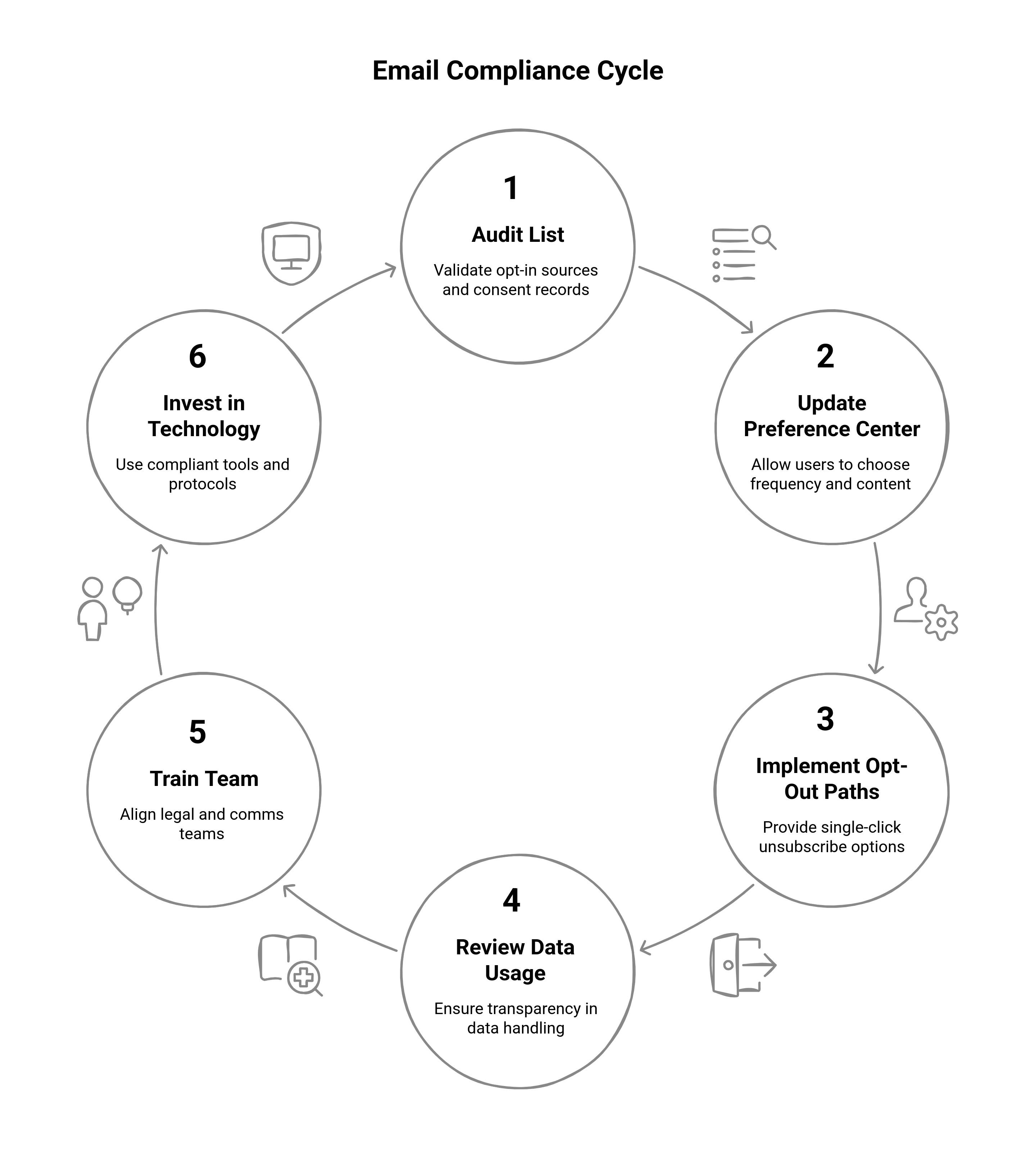
Audit your list: verify opt-in sources and consent records
Start by looking into the health of your current email list. Where did your contacts come from? Is there any proof of their consent? Under today's email compliance laws, none of these things can be assumed or collected from some third-party lists. Clear opt-in trails are necessary, especially where governed by GDPR, CASL, or CPRA. Establish systems to preserve and timestamp consent records with acquisition sources, consent wording, and any subsequent modifications. Regularly clean and maintain your list to a status of exemption for inactive, bounced, or unsubscribed contacts.
Update Your Preference Center
Let subscribers govern their experience. A well-designed preference center will allow users to adjust the following:
Frequency of emails
Months of content (newsletters, promotions, and product updates)
Types of communication channels
In turn, user engagement rates will rise, while you will align well with email marketing legislation emphasizing user autonomy. Failure to provide granularity of communication preferences in certain jurisdictions, like the EU or California, could amount to a contravention of data privacy laws.
Implement Clear Opt-in Paths
Moving an unsubscribe option should be frictionless: one click, no login, and no guilt trip. Such practices are required by law under CAN-SPAM, and modern users expect them. Every marketing email must contain an unsubscribe link that is both visible and functional. You might also consider offering an option to "pause" or "reduce frequency" for those customers who may be hesitating to opt out completely. Just remember, if someone wants out, let them go in peace. Anything less will put you at risk of email compliance.
Review and Log Data Usage Disclosures
Examine and record the data usage disclosures. These days, disclosing how your customer data is being handled to the fullest extent is a matter of email compliance law. Any use of customer data for personalization with respect to behavior, sharing data with partners, or integrating with CRMs must be mentioned prominently, mostly as a note in the email footer or as a link to your privacy policy. Equally important is to keep a list of such disclosures. What did you tell the users when they subscribed? When was there a last update on the privacy language? If questions arise from the regulator's side, documentation will speak for you.
Educate Your Marketing Team
Your tech and legal teams may own the framework, but your marketing department upon execution. It is an absolute must for anyone writing, scheduling, or sending an email to understand the essentials of email compliance; this is particularly so for global campaigns, as email marketing laws vary from one region to another.
Regular refreshers for your marketing, legal, and data teams will help gain alignment. This can include final checklist processes for sending, internal approval workflows, and automated alerts concerning any compliance issues, such as missing unsubscribe links or outdated legal text.
Invest in Technology
With appropriate tools, email compliance will become more extensible and trustworthy. Look for Email Service Providers (ESPs), Customer Data Platforms (CDPs), and consent management tools that provide for:
Automatic handling of opt-out requests
Versioning of consent and maintenance of audit logs
Regulatory compliance at the regional level (e.g., GDPR flags, CCPA tagging)
Encryption of data and secure access
The marketing tech stack of the future needs to be designed for email compliance and cannot be adjusted after the fact in case something goes wrong. An excellent platform takes compliance into account by default, so that manual error is reduced.
Different Regulatory Frameworks in Place
Understanding the global email compliance landscape is critical for avoiding legal risk. Here’s a quick breakdown of key regulatory frameworks shaping email marketing laws in 2025.
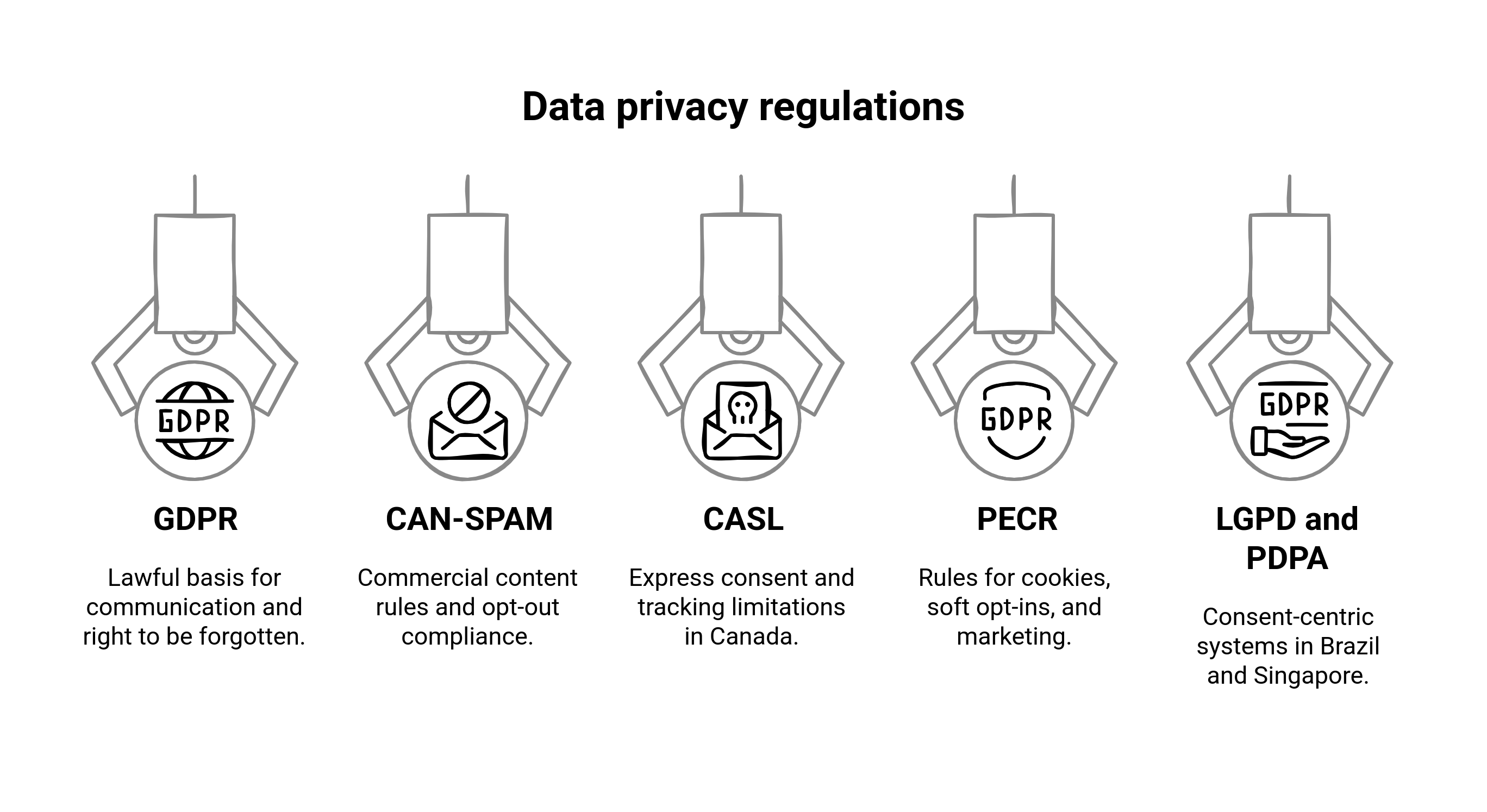
GDPR (Europe)
- Requires a lawful basis (typically consent) for sending marketing emails.
- Users have the right to access, rectify, or delete their data ("right to be forgotten").
- Data processing must be transparent and well-documented.
CAN-SPAM (USA)
- Allows sending commercial emails without prior consent, but mandates a clear opt-out.
- Requires accurate subject lines, sender information, and inclusion of a physical address.
- Opt-out requests must be honored within 10 business days.
CASL (Canada)
- One of the strictest email compliance laws globally.
- Requires express consent before sending emails.
- Prohibits installation of software or tracking without user permission.
PECR (UK)
- Governs marketing emails, cookies, and electronic tracking.
- Allows "soft opt-in" for existing customer relationships.
- Works alongside UK GDPR for data privacy law enforcement.
LGPD (Brazil) & PDPA (Singapore)
- Both laws require clear consent for collecting and using personal data.
- Emphasize data minimization, purpose limitation, and user control.
- Align closely with GDPR principles but with regional enforcement differences.
CPRA (California, USA)
- Builds on CCPA with stricter rules around data sharing and consumer rights
- Requires transparency in how user data is used in emails.
- Includes provisions for email tracking and opt-out from data sales.
Upcoming Trends in 2025
- AI-generated content disclosures may become mandatory in email communications.
- Biometric and behavioral tracking (via email interactions) is under review by privacy regulators.
- Consent lifecycle automation is emerging as a best practice—tracking, refreshing, and retiring consent across the customer journey.
Conclusion
In 2025, email compliance is no longer just about avoiding legal trouble—it’s a competitive advantage rooted in trust, transparency, and accountability. As email marketing laws continue to tighten and global data privacy laws evolve, brands that treat compliance as a foundational part of their strategy—not a last-minute check—will stand out in the inbox for the right reasons.
Whether you're navigating GDPR, CAN-SPAM, CASL, or preparing for the next wave of AI-driven email regulations, the playbook is clear: earn consent, protect data, communicate honestly, and give users full control over their interactions. These aren’t just legal requirements—they’re the building blocks of ethical and effective marketing in a privacy-conscious world. The future of email belongs to those who lead with respect. By embedding strong email compliance practices into your campaigns today, you’re not just staying out of trouble—you’re laying the groundwork for higher engagement, stronger loyalty, and long-term brand resilience.


