

Introduction
Nowadays, the world’s attention spans seem to be dwindling, and customer expectations are soaring. Personalization has indeed crested into something more than just a competitive advantage; it has become the very basis of modern digital experiences. However, existing methods of personalization predominantly relied on static rules and generic segments that neither tracked real-time behavior nor engaged in user-centric approaches. AI-powered personalization, on the other hand, transforms the game by providing tailored experiences at scale, leveraging machine learning and data intelligence, and adapting dynamically to an individual's needs, wants, and intents. AI goes beyond just automating personalization; it literally recreates the entire notion. AI-powered personalization is rapidly becoming the substrate on which organizations intending to gain a competitive edge in customer-driven markets lay their meaningful and measurable CX outcomes.
In this complete guide, you will learn about everything from how AI-powered personalization works to the big no-nos that businesses should avoid in adoption. If you are in marketing, product, CX, or data science, this is your path to realizing a smarter, faster, personalized customer experience. Are you ready to move beyond personas and straight into precision? Let's dive into the AI revolution shaping personalization for 2025 and beyond.
What is AI-Powered Personalization?
AI-powered personalization refers to the use of artificial intelligence, particularly machine learning and data-driven algorithms, to tailor digital experiences to individual users in real time. Unlike traditional personalization, which relies on static rules or predefined user segments, AI-driven personalization continuously learns from user behavior, context, and intent to deliver hyper-relevant content, offers, messaging, and product recommendations.
Here, we're not talking about "using a customer's first name in an email." We're talking about sending a tailored message to the right user at precisely the right time and based not on assumptions but rather on real-time signals. This concept of personalization with AI is a continuous, ever-adapting process with data feeds and ambient intelligence rather than predesigned processes. This leads to a far more proactive, contextual, and engaging user experience that feels natural and individualized.
From the Traditional Approach to AI Personalization
Traditional personalization usually works on simple rules: "If a user is in Segment A, show Offer B." These rule-based methods, after all, are static, often predefined by marketers or developers, with little flexibility to allow for nuance or real-time adaptation. Up to a point, these systems work. However, they break down in instances of unexpected user behavior, increased workload from unexpected users, or an expansive pool of variables.
In contrast, AI-powered personalization works on almost a real-time basis using predictive-adaptive models trained on huge amounts of data to analyze the intent of the user action and modify the experience accordingly. Instead of assuming what a user wants based on broad segments, AI learns from patterns in user behavior- clicks, scrolls, purchase history, channel preferences, and even sentiment- to automate personalized decisions. It is almost like drawing a line between a playbook and a self-learning engine that is writing itself.
Rise of Hyper-Contextual Experiences
Today, in a multi-touch environment where users engage with everything from mobile apps to websites, social media to email, chatbots to email, context becomes vital. With AI, brands can create hypercontextual experiences that adapt not only to the identity of the user but also to their journey, device, time, and cause of the activity-associated behavior.
For instance, an AI system can tell if a returning customer is on a mobile website during a commute and respond by creating a one-click reorder experience or recognize a first-time visitor from an enterprise IP address and dynamically surface enterprise-focused content. What makes such scenarios possible is the ability of AI to process signals in real time and personalize them according to individual contexts rather than static cohort assumptions.
Types of Personalization
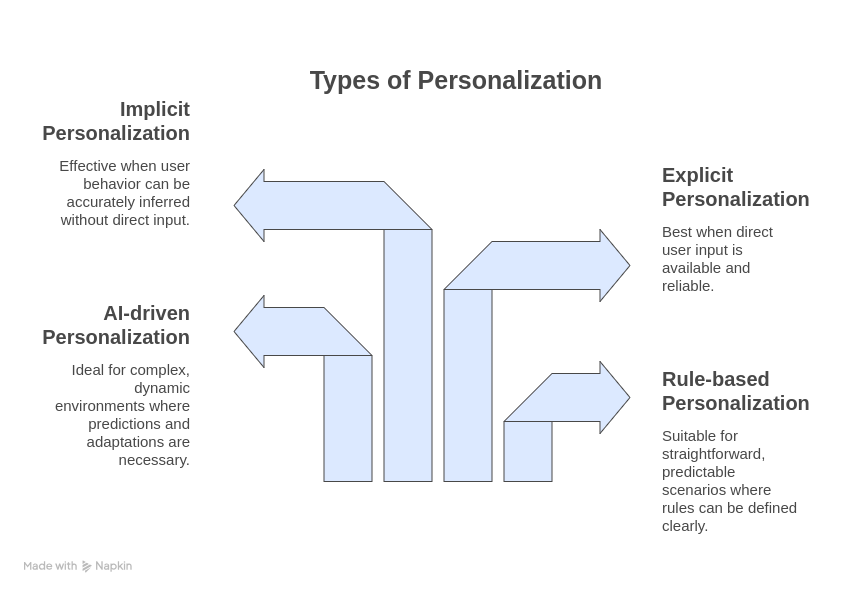
- Rule-based (Legacy) vs AI-Driven (Predictive, Adaptive): Rule-based personalization has manually defined conditions, as in "showing X banner to Y audience", and most of the times fails to scale or predict behavioral deviation. On the other hand, AI personalization for the reason bases prediction models for creating recommendations or experiences automatically or based on continually evolving data models.
- Predictive personalization can use earlier data for prediction about future action (e.g., likelihood to purchase, churn risk), while adaptive personalization adjusts the output over time based on changing user behavior. These two approaches thus empower the shift from reactive to proactive personalization.
- Explicit vs. Implicit Personalization; Explicit personalization is based on user input such as preferences or interests directly selected by them or by submitting a form. Although useful, explicit personalization is often restricted by the user; less effort is sometimes made, or users may decline to share information willingly. Implicit personalization makes inferences based on observed behavior, such as browsing behaviors, scroll depth, session duration, or purchase frequency. AI has great potential in such domains and seeks out patterns humans would have otherwise missed, inferring intent from subtle signals across touchpoints.
Superimposing any explicit data with deep behavioral inferences to create holistic, dynamic patterns regarding users is what AI can offer.
Key Technologies Involved
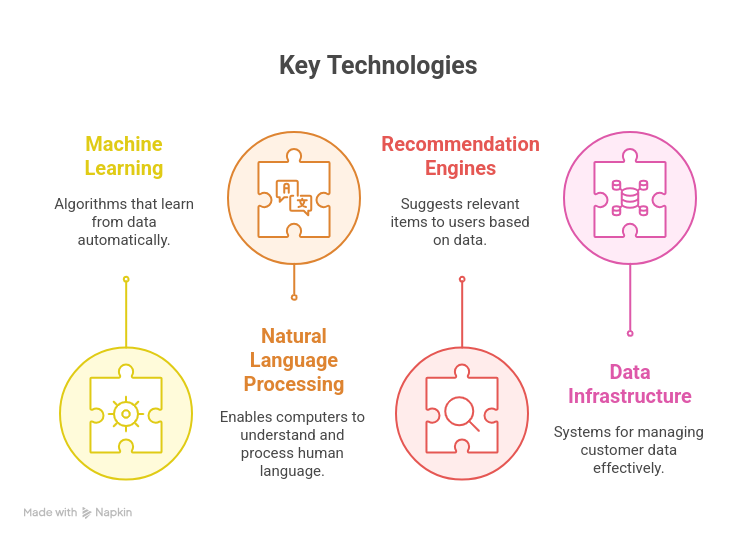
- Machine Learning & Deep Learning: At the crux of AI-powered personalization are machine learning algorithms. These algorithms are programmed to derive patterns from user behavior, make predictions-such as in product affinity or churn, and adapt their models over time as new data is-ingested. Deep learning is directly linked to being able to personalize beyond the obvious, such as with image- or voice-based recommendations, emotion recognition, or automated content generation.
- Natural Language Processing (NLP): This definition fits the use of users and machines understanding and making human language intelligible to each other, the greatest application of understanding and producing personalized content, product description, conversational types of interaction, e-mail subject lines, and more importantly, to the core of their interaction with artificial intelligence systems. It allows brands to process user-generated content like reviews, chats, etc., and recognize sentiment-aware tone and content relevance, which helps them relate to the users.
- Recommendation Engines: Unlike pure statistical recommendation systems, which use collaborative filtering, content-based filtering, and hybrid models as algorithms, it provides suggestions for improving relevance maximized by interaction; every time the user is engaged, it goes through evolving improvements.
The Data Infrastructure: CDPs, DMPs, CRMs, and APIs
- Customer Data Platform (CDPs): Integrates multiple sources of data into persistent, identity-resolved user profiles.
- Data Management Platforms (DMPs): Use anonymous user data for advertising and targeting purposes.
- Customer Relationship Management (CRM): Stores transaction and communication history.
The whole structure instantiates through APIs and data pipelines in real-time, thus allowing AI engines to act on signals based on behavior instantly. Therein lies the value of being able to synthesize personalized experiences across channels, devices, and lifecycle stages.
How does AI-powered Personalization work?
AI-empowered personalization isn't a plug-and-play construct; it is an intelligent system that consists of stacked technologies, real-time data processing, and predictive decision-making. At its heart, AI-powered personalization deals with continuously transforming user signals into customized experiences through data collection and analysis, prediction, and action. This section explains all the finer points pertaining to the key layers of how this engine works in the real world.
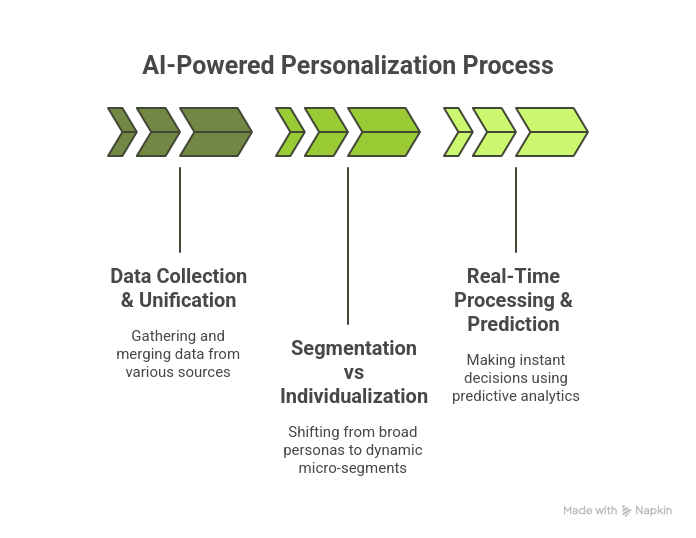
Data Collection & Unification
Any AI-driven personalization system starts with the availability of data, and a lot of it. User data needs to be detailed and multi-sourced before it can be relied on to draw any worthy pattern. This encompasses:
- First-party data: Web or app interaction data, purchases made on web/app, CRM data, email engagement data.
- Second-party data: Partnerships or shared-user insights from trusted sources.
- Third-party data: Demographics, firmographics, and intent signals are purchased from the data provider.
- The ingested data is unified into one pool/profile, usually in a Customer Data Platform (CDP). The CDP solves the identities across devices and touchpoints, allowing a single customer view that informs personalization throughout the customer journey.
In the absence of such unified data, any attempt at personalization will look fragmented and incoherent, whereas with unified data, AI conducts holistic and context-based decision-making that feels personalized and cohesive.
Segmentation versus Individualization
Traditional personalization is largely based on scientifically static segmentation: Users are grouped by what they share in common, industry, behavior, and demographics. This is, again, a paradigm ruptured by AI. Instead of working with pre-defined personas, what AI does is that it constantly identifies micro-segments in real time—behavioral clusters that emerge dynamically as per what the users do, not who they are on paper. This allows the system to:
Instantly respond to behavior shifts such as product abandonment or repeat site visits.
Pick up on fine intent signals that go beyond surface-level traits.
Serve content based on what is presently relevant as opposed to just what is relevant in historical terms.
The most advanced systems then go all the way to individualization: true 1:1 personalization, where every experience is custom-built for a particular user based on real-time decisions.
Real-Time Processing and Prediction
AI is distinct from rule-based personalization by virtue of its ability to process information in real time and predict instantaneously. This consists of:
- Event tracking: Tracking each and every interaction (clicks, views, searches, scrolls) as live signals.
- Predictive modeling: Anticipating what actions the user might take next (purchase, churn, engage).
- Content delivery: Serving a personalized asset, product, CTA, message, based on that prediction.
For instance, if the user has read multiple blogs on enterprise solutions, the system may justify showing a case study with a Fortune 500 client, predicting that the user has entered the consideration phase of a B2B buying journey. Often, these systems use reinforcement learning, where the AI continuously improves its model by how users react to personalized experiences, increasing accuracy and impact over time.
Key Components in Action
Algorithms Behind the Magic: Collaborative Filtering
Recommend content based on what users with similar tastes liked
Content-based: Recommend items like those the user has interacted with.
Deep Learning Models: Utilizing visual recognition, NLP generation, or sentiment analysis when it comes to defining complex relationships between data points and user behavior.
Multi-Armed Bandits: An alternative A/B testing technique — the algorithm dynamically allocates more traffic to the better-performing variation in real-time. All these algorithms together create a personalization engine that is scalable and context-aware.
Personalization Triggers and Decision Trees: AI personalization is triggered by a contextual trigger — a variable helping decide what content gets delivered. Some common inputs for triggers include:
Device channel (example: mobile vs desktop)
Time of the day & how recent the visit was
Geolocation & weather
Referral channel (example: ad, email, organic)
Behavioral metrics (example: scroll depth, dwell time, rage clicks)
Sentiment signal (through chat, reviews, email)
These signals then drive the decision tree-based algorithms to identify the best option to serve the right content dynamically. For example, a system could decide to:
Serve a limited-time offer to users visiting at night on mobile
Show a chatbot asking if they need help after 3 seconds of no activity on pricing
Recommend a different homepage layout for B2B versus B2C visitors
These are not hard-coded decisions; these are made in real-time, tested for effectiveness, and improved automatically via feedback loops.
Benefits of AI-Powered Personalization
AI-powered personalization is more than just a customer experience booster—it’s a business growth engine. From higher revenue and deeper loyalty to operational scale and efficiency, its impact spans across every layer of a modern digital organization. Let’s break down the core benefits through three lenses: business outcomes, customer experience, and operational performance.
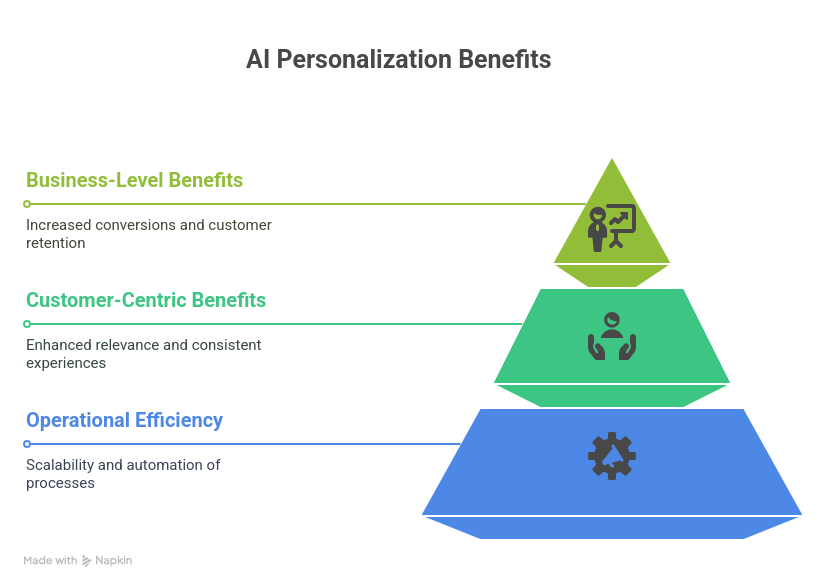
Business-Level Benefits
Perhaps the most immediate and measurable benefits of AI-driven personalization are conversions and average order value. By engaging the most relevant products, offers, or content according to real-time user behavior, AI minimizes friction along the buyer's journey and boosts the probability of purchase. Incremental contributions occur all along the customer journey through increasing sales via personalized product recommendations on PDPs and checkouts, tailored email subject lines, and context-aware landing pages, often in the double-digit percentage range. AI personalization achieves greater client retention and lifetime value (LTV) by actually being able to adapt over time to a user’s changing preferences. That is, instead of treating repeat visitors like new users, AI remembers their behaviors, customizes experiences to their ongoing journey, and facilitates deeper engagement. Customers who feel appreciated and served in a personal manner will return, spend more, and remain for longer, which again would directly benefit long-term business performance.
Further, by recognizing drop-off patterns, such as churn and cart abandonment, AI can proactively intervene in real time. Let us say a high-intent user hangs on the checkout page for a while before not really completing the purchase. Well, then it could be a perfect time for the system to send him an exciting offer or a reassuring message. On subscription-based platforms, predictive churn models can identify at-risk users and offer personalized retention campaigns before they actually disengage. These AI-led micro-interventions can add up to revenue preservation.
Customer-Centric Benefits
From the angle of enhancing user familiarity, AI-powered personalization contributes meaningfully by increasing relevance and removing friction on digital touchpoints. Whether it be content of interest, product suggestions relative to past preferences, or dynamic filtering shaped by behavior, users find what they are looking for faster and with less effort. Relevant to the task at hand, users have reduced cognitive load, making even the simple interaction uncomplicated. To those, AI adds delightful surprises. Serendipity brings forth something that is valuable to the user but for which they have no perception of needing: an unexpected yet spot-on song on Spotify, for example, or the perfect extra item suggested just before eCommerce checkout. These "wow" moments are facilitated through deep behavioral learning and context-aware recommendation engines that move beyond basic logical attributes.
Experiencing sustainability across touchpoints is perhaps equally important. AI ensures that personalization experiences feel like a unified whole rather than something fragmented, no matter if the user is engaging on mobile, desktop, email, app, chatbot, or social. This builds trust, diminishes confusion, and fosters a sense of fluidity within the customer's journey—one of the most vital elements in the determination of modern CX excellence.
Operational Efficiency
AI personalization has scale across millions of users, which traditional methods simply cannot match. The good old ways meant documenting upfront hundreds of audience segments and managing them; AI handles and acts immediately for every single user in real-time for micro behavior, even making 1:1 personalization possible, but without growing team and workload amounts. Also, AI automates experimentation and optimization; testing becomes more rapid and smarter and, of course, continuous using AI-based systems capable of real-time provision of multiple variations and allocation-adjust based on performance experienced instantly optimize outputs using reinforcement learning or multi-armed bandit frameworks rather than performing expensive A/B tests for weeks with some analysis after. Essentially, the speed of feedback is increased, and you no longer have to wait for human input before being able to deliver the best performance. Ultimately, AI crushes manual segmentation and rule-based systems. Marketers and product teams don't have to come up with complicated logic trees anymore and guess which parameters really matter. Instead, the system surfaces actionable insights, auto-generates segments, and provides optimized decisions-evolving humans out of the micromanagement and allowing the team to redirect focus on strategic initiatives rather than operational grunt work.
How Does AI-Based Personalization Enhance the Customer Experience?
Today's customer experience is not conditional solely on product quality or service speed; rather, it is defined by how well a brand comprehends and responds to its users' needs. AI-powered personalization improves CX by making interactions smarter, swifter, and more emotionally resonant. It creates life, turns the static experience into a living, adaptive journey with intuition, and feels like a human touch. Here's how it beautifies CX in all dimensions.
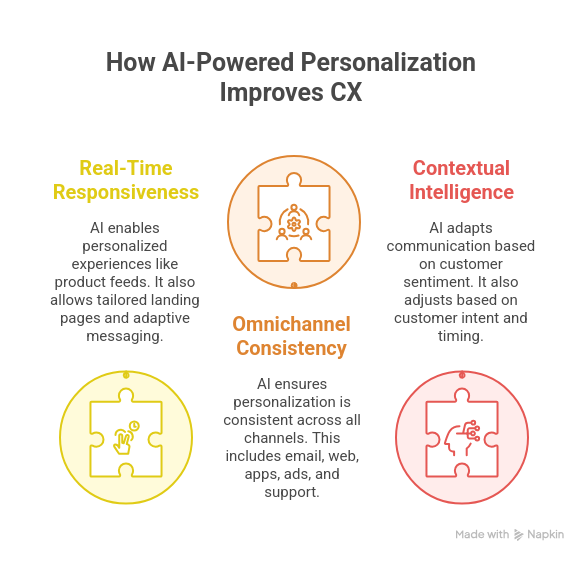
Real-Time Responsiveness
With AI, brands can respond to users at the moment of need and not hours or days later. This real-time responsiveness changes the whole behavior of users on digital platforms. For example, a returning visitor could be shown a personalized product feed based on last viewed items, a dynamic landing page showing his/her industry segment, or adaptive messages that change depending on where they are in the funnel. Such micro-personalizations instill in the users a sense of relevance and immediacy to take action. Unlike rule-based systems that often take the backseat to user behavior, AI reacts instantly-shortening the decision-making process and fostering engagement.
Omnichannel Consistency
Disjointed experiences across different touchpoints are among the biggest frustrations for users. This is precisely where personalization through AI fills the gaps with omnichannel synergy in such a way that preferences and behavioral insights across the web, mobile apps, email campaigns, paid ads, and customer support systems are kept in sync. A user clicking on product details in an email can then get a notification alert in-app, see a relevant retargeting ad later, and even chat with a bot that recalls and continues from previous inquiries. This consistency removes the mental fatigue associated with switching contexts, strengthening brand trust, and ensuring that every touchpoint feels part of a well-coordinated journey rather than a series of ill-coordinated encounters.
Contextual and Emotional Intelligence
But with AI, optimizing not only what to show but also learning how and when to do so. Based on intent signals and sentiment analysis, for example, through contextual and emotional intelligence, AI systems can adapt their tone, format, and timing of communication. If a user is frustrated with a chatbot, the tone is switched from promotional to sympathetic. If someone visits the pricing page but does not convert, the system might show them educational content instead of a hard sell for the product. Natural language processing and intent-prediction models enable this nuanced responsiveness, thus humanizing the digital experience and inducing a feeling of genuine understanding from users.
Role of Conversational AI
Conversational AI, such as intelligent chatbots and voice assistants, has a major impact on improving customer experience through personalized two-way conversations. Unlike the traditional bot, which has a script in place, a modern conversational AI-powered assistant actually understands intent, sentiment, or what else the user has done with the organization. The bot can respond to support questions, make product recommendations, explain complex workflows to users, and upsell — all in a normal human-like format. Such systems present support as a channel for sales and change conversations to relationship-building moments. AI will not only answer questions but also give predictions before the need arises, have vivid memories of chats had previously, and tailor the answers accordingly.
Case Studies
Top digital-first brands have been able to really dig deep into AI personalization with the aim of achieving absolutely world-class CX. Netflix has "tweaked their personalization" down to real-time viewing behavior and collaborative filtering so that no two homepages are alike. Spotify's Discover Weekly and Daily Mix playlists use deep behavioral learning to surface songs that feel curated. Amazon's predictive modeling is not only used for product recommendations; it is used for optimizing delivery suggestions and bundle offers based on prior behaviors. Sephora ties personalization across eCommerce and in-store experience using AI-driven Shade Finder and Virtual Artist tools — merging data and experience to guide beauty purchases with pinpoint accuracy. The magic for consumers is that if done well, personalization becomes an experience, not a marketing tactic.
How to Implement AI-powered Personalization?
Executing AI-powered personalization is not as easy as pressing a switch; it is about forming a strategic data-based ecosystem that encompasses the ability to learn, scale, and adapt in time. This section is therefore divided into three phases: Strategy & Readiness, Data & Technology Stack, and finally, Launch & Scale. This plan will seamlessly guide you in building a personalization engine that will yield a measurable impact, irrespective of whether you are starting from scratch or wish to evolve with an existing setup.
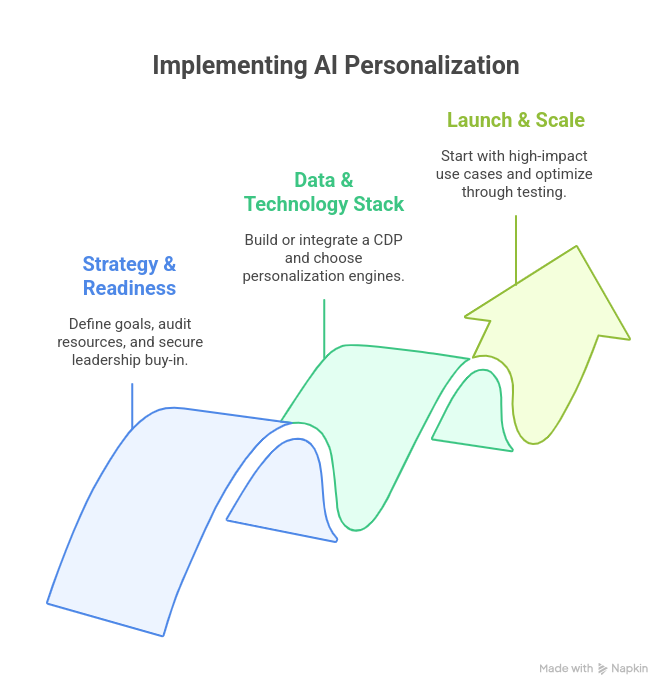
Phase 1: Strategy & Preparedness:
Before touching any technology, define first clear business goals. Improving customer retention? Increasing average order value? Driving more engagement across touchpoints? Without the sharp-edged goal around which implementation will coalesce, efforts in AI may get diluted or misaligned. Everything will feed into your use case, tech stack, and performance metrics decisions later.
Then, do a personalization readiness audit. Details of all current data sources from web analytics, CRM, and purchase history to mobile behavior and support logs must be assessed along the lines of how clean, unified, and accessible these data are. Check if your current infrastructure, including marketing automation tools, CMS, and analytics, can support real-time personalization. It tests your internal team structure: Do you have data engineers, product owners, or marketers who know what to do with AI outputs? This phase requires alignment at the organizational level. AI personalization touches data privacy, content strategy, customer support, and revenue operations. Leadership backing for investment prioritization and legal/compliance alignment to ensure data practices meet regulatory standards (especially those having to do with PII or that exist in the GDPR/CCPA region) will thus be necessary. Without this strategic underpinnings technology will fall.
Stage 2: Data & Technology Stack
So you've got strategic alignment, and now it's time to develop the core bones of your AI personalization engine: data and tech stack.
In fact, at the core of your architecture would be something like a Customer Data Platform (CDP), be it Segment, Fragmatic, or Tealium. A CDP unifies and integrates customer data coming from all possible sources, be it web, mobile, CRM, or transactional systems, into a single, persistent user profile. This is what fuels intelligent recommendations, behavior-triggered journeys, and predictive segmentation.
The next step is to decide on the AI personalization engine. One can go for internal development (ideal for very large enterprises with data science resources) or connect with specialist vendors. Ready-to-use solutions like Google Vertex AI, AWS Personalize, or Azure ML offer integrations that permit the use of machine learning through plug-and-play with the CDP and content platforms. These platforms can now create models based on user behavior and predict preferences while optimizing experiences across channels. And don't forget the middleware layer: APIs, automation platforms, and connectors that make it easy for your personalization engine to integrate with customer touch points (like your website CMS, email platform, mobile app, ad tech stack). Without real-time integration, however, your personalization efforts will lag behind and deliver old or irrelevant content.
Phase 3: Launch & Scale
Once the infrastructure is ready, high-impact, low-risk use cases can be deployed for showing early wins and momentum. Common starting points are personalized product recommendations, behavior-based email journeys, smart content blocks on landing pages, and intelligent onsite search. The initial focus is on use cases that drive the organization's core KPIs-conversion rates, engagement, or retention.
Once live, move into continuous optimization. Use A/B testing frameworks alongside reinforcement learning, allowing the AI system to dynamically adjust content or offers based on real-time feedback. For example, you might start by testing two product recommendation models, "frequently bought together" vs. "you may also like," and let the AI allocate more traffic to the higher-performing variant automatically.
Personalization-specific KPIs have to be monitored at scale:
- Personalization accuracy (e.g., % of recommendations clicked)
- Conversion lift vs. control
- Churn reduction over time
- Time-to-value (how fast new users see personalized content)
- Validating that the system is achieving results on experience and business outcome fronts, something these metrics will help with.
Why Most Businesses Fail in Implementing AI-powered Personalization — How to Fix Them
While the views held by businesses, in accordance with AI and its power, tend to support the idea of personalization, most of the businesses technically do not go beyond superficial implementations or experiments in the pilot stage. Rarely does this set of reasons include the technical ones; the objections range from strategic to structural and, of course, include the cultural perspectives. In the sections below, we have identified the most frequent points of failure, as well as clear solutions, to turn these pitfalls into solved problems.
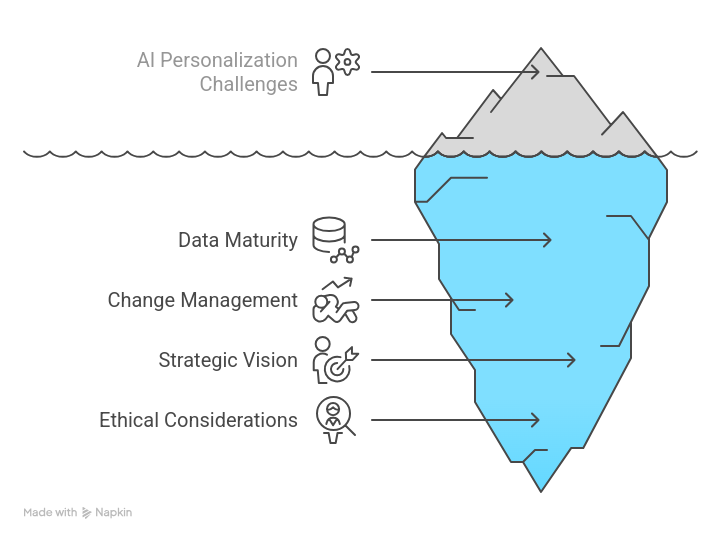
Lack of Data Maturity
Poor data maturity is among the leading causes for which personalization efforts fail. Many organizations consist of disconnected data silos: customer behavior data in one system, transactional data in another, and support logs in another system. Without unified, high-quality data, AI systems fly blind. Much more absent is real-time data availability; as such, experiences are based on stale or incomplete information. Begin with an investment in a strong Customer Data Platform (CDP) to centralize and cleanse customer data from all touchpoints. Equally important are data governance protocols for accuracy, compliance, and consistency in the whole organization.
Underestimating Change Management
AI implementation is not merely a technical upgrade, it is a change in how decisions are made and how experiences are delivered. Businesses fail because they do not recognize the cultural resistance to AI. Team members may distrust automation, fear displacement from their jobs, or simply resist changes in lengthy processes. Internal buy-in, despite having the most robust AI engines, will fail to drive efficiencies. In this case, companies should invest in educating their employees, creating cross-functional work teams to achieve their goals, and starting with pilot programs championing rapid winning shows.
Overreliance on Tools Over Strategy
Too many businesses jump into personalization by purchasing technology first—AI platforms, recommendation engines, or CDPs—without a clear strategic roadmap. They hope the tool will define the solution; however, without clarity on goals, target audiences, or content strategy, these platforms become expensive line items with limited output. The key is to flip the order: Define high-value use cases first, aligned with specific business outcomes such as upsell, retention, or onboarding optimization. Then, select or configure the tools best suited to those use cases. A strategy-first approach ensures that technology serves the goal, not the other way around.
Neglecting Privacy and Compliance
Personalization walks a thin line between helpful and creepy. When AI systems use customer data without transparency or consent, the outcome is not delight but rather distrust. Regulatory environments such as GDPR, CCPA, and DPDP are tightening the screws on how customer data is being collected, stored, and used. Still, many organizations fail to engrain privacy-by-design principles into their personalization stack. The remedy is two-fold: establishing transparent opt-in and preference management and subscribing to ethical AI principles that guarantee an explainable, nondiscriminatory, and user-respecting decision approach. Personalization should feel like a service, not surveillance.
Measurement Gaps
Though able to launch personalization successfully, many companies fail to assess its actual impact. Traditional KPIs like CTRs and open rates offer only a cursory view. Without clearly defined frameworks for ROI attribution, justifying the continued investment or the scaling of efforts becomes difficult. Companies need to get deeper into personalization accuracy measurement, conversion lift over control, churn reduction, and even long-term customer value. Those KPIs must be tied back to the core business metrics and updated regularly. Building a closed-loop measurement system would enable continuous learning, refinement, and proof of business value at scale for personalization.
How to Use AI-Powered Personalization for Competitive Advantage
AI-powered personalization isn't merely an extra trick to enhance conversion; it is a truly strategic engine that can set specific brands apart in today's increasingly saturated and commoditized marketplace. Changing buyer expectations toward hyper-relevance and real-time responsiveness put a premium on organizations that are willing to embed personalization into every single layer of the customer journey for long-lasting and defendable benefits. Here's how:
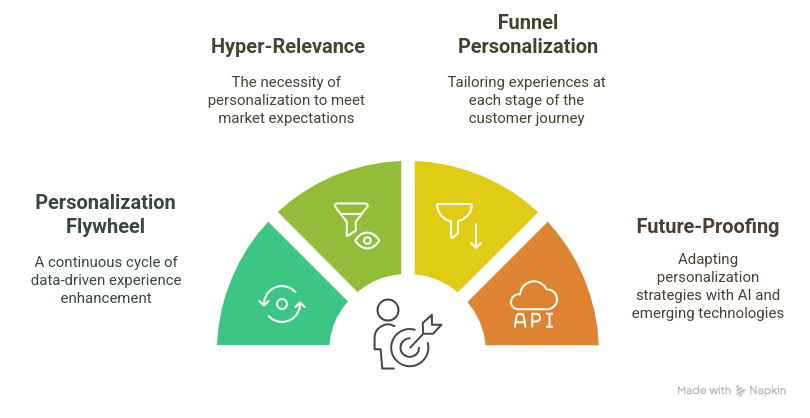
Personalization Flywheel in the Making
Personalization is not a one-time act; it is self-sustaining machinery. Well-done and strongly engaged customers are set into a flywheel: the more relevant and contextual your experiences, the more engaged they are. More engagements lead to rich behavioral data, thus leading to smarter personalization. This feedback continues, thereby exponentially improving gains over time. A personalized product feed gets more clicks, which then helps the AI understand preferences that lead to more accurate recommendations. Winning players are those who continually feed and tune this loop, not just whenever they run a campaign but as a layer of always-on experience.
Hyper-Relevance as a Differentiator
Hyper-relevance has supplanted convenience as the ultimate competitive weapon in the digital domain. The customers are inundated with content, offers, and touchpoints; cutting through that din requires serving them just what they need, when they need it, in the proper context. Personalization was once a "delighter"; now, it’s just expected. A landing page that greets users by name, a chatbot that remembers past conversations, or an email offer that adapts to previous purchases—these are no longer innovations but table stakes. What sets market leaders apart is the ability to deliver hyper-relevant experiences at scale and with consistency across the entire user lifecycle.
Personalization in Each Stage of the Funnel
True competitive advantage does not come from mapping personalization just at the bottom-of-the-funnel conversion points. At the top of the funnel, personalization will dynamically tailor ad messages based on the search behavior of the user, demographic data, and intent signals, showing the most relevant content to the users. Websites and apps can serve smart content recommendations, testimonials, or case studies based on industry, role, or pain point during consideration. At the decision stage, AI can adjust pricing models, bundle offers, or trigger personalized nudges (like urgency messages or loyalty bonuses) depending on signals of purchase intent. Personalization is applicable even post-purchase; AI could walk with each user through retention journey activities such as proactive support, loyalty programs, and win-back campaigns. This way, full funnel personalization ensures that no phase of the journey feels generic.
Future-Proof Your Strategy
To stay competitive, personalization must evolve with AI. We are now entering an era of AI agents and generative experiences, where personalization will cease to be merely reactive and begin being predictive and sometimes even creative. AI agents will independently test, learn, and optimize user experiences with little human assistance. The rise of synthetic users (AI-generated personas that mimic customer behavior) enables businesses to pre-validate journeys ahead of launching them in live mode. Generative AI can produce unique product descriptions, emails, or landing pages in real time based on individual behavior, while predictive personalization is advancing into a forecasting mode: not just what a customer wants today but what they will need tomorrow. The sooner companies embrace these AI evolutions, the better they will be poised to build adaptive and future-ready personalization engines for intelligent scaling over time.
Conclusion
AI empowerment personalization has moved from tactical enhancement to a core strategic need. In an economy where attention is scarce and expectations are sky high, a business cannot afford to serve generic one-size-fits-all experiences anymore. Today, the crucial differentiator is not merely the ability to personalize but the capacity to intelligently, contextually, and at scale. AI gives that speed, precision, and flexibility to be where the customers want them to be- at every touchpoint, instant, and micro-decision.
However, successful personalization is not about some fancy tool; it begins by being data-ready with a clear strategy and cross-functional alignment, along with deep respect for privacy. As we have discussed, the major failure points are not so much constraints of technology but rather gaps in vision, execution, and measurement. The businesses that will distinguish themselves from competitors in ways that will engender lifelong customer loyalty will be those that view personalization as a living, adaptive capability to leverage rather than a one-time event. Autonomous, predictive, and generative personalization is the way forward. Those who invest wisely and early will not only generate attention but also build trust, increase lifetime value, and create a sustainable competitive advantage. Strategy fuels the AI engine, and right now is the time to activate both.


